Locations






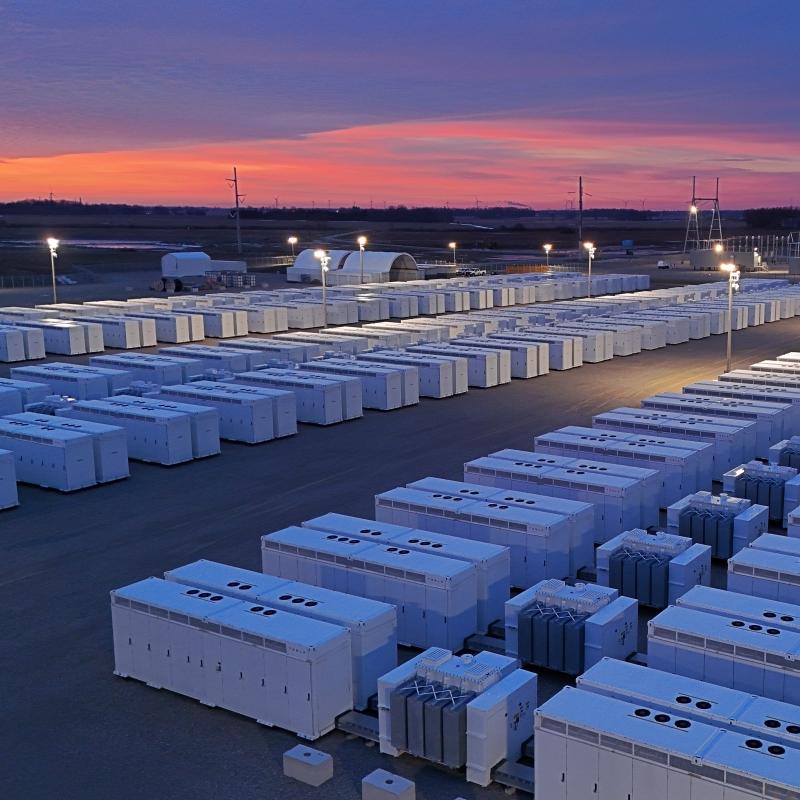
Amid increased discussion of Canada's need to provide ever more electricity to power such things as artificial intelligence processing, the country’s largest battery energy storage facility has come online in Ontario.
The Hagersville Battery Energy Storage Park — located in Hagersville, just southwest of Hamilton — went online on Feb. 18.
It offers a 300-megawatt (MW), 1,200-megawatt-hour battery capacity, and is operated through an equal partnership between Boralex (BLX-T) and the Six Nations of the Grand River Development Corporation (SNGRDC).
“The project will be helping to bring stability and capacity to Ontario’s grid as the province is facing growing energy demands,” according to Shelby Dockendorff, advisor, public and government affairs at Kingsey Falls, Que.-based Boralex, who spoke with Sustainable Biz Canada.
The 10-acre battery energy storage systems facility runs on 334 Tesla Megapack 2XL lithium-ion batteries. Construction began in August 2024, and it completed final testing in December.
“We did permitting for about over a year, getting everything ready for the facility. We were working... to get our permits through to make sure we could have everything we need,” Dockendorff said.
Getting the locals on board
As the technology is relatively rare, the company knew it had to conduct multiple community consultations to get local buy-in.
“It’s a new technology for a lot of people... People wanted to understand, especially the local community, how big is it going to be? Is it going to be loud? We worked very closely with the community to make sure they had updated renderings about what the site would look like as we were headed into construction,” Dockendorff said.
The consultation was not a one-way street, she added.
“We worked with them because we have a three-kilometre transmission line from the site to connect into the grid, and the first area where we were running that line, the community was a little bit hesitant of where it was going, so we’ve actually moved the line and worked the community so that it would be in a better spot.”
“It was making sure that people, the community, felt comfortable with what was going into the area,” Dockendorff said.
Working with Six Nations of the Grand River
For SNGRDC, the facility promises to provide a minimum of $1.7 million per year in revenue for the length of the 20-year contract. “We’ve partnered with them on several other projects, including our Niagara Region wind project, as well as another battery project that we’re looking to build in Oxford County that’s just about to go into construction.”
The contract was offered through the Independent Electricity System Operator (IESO) in an expedited long-term request for proposal in 2023. At its height, there were “approximately 200 construction jobs, and there is one or two operator jobs now that the facility is operational,” according to Dockendorff.
“We are fortunate that in Ontario the regulators and utilities understand and can manage this. In other jurisdictions, it may take time to educate the(m) about how to use energy storage to their maximum benefit."
How the battery system works

“We take power during off-peak hours, so it’s usually around nighttime, and we store the power into the batteries, and then we put (it) back out on the line during peak hours, and that helps ensure a stable and reliable grid,” Dockendorff explained.
Despite the current frigid temperatures which gripped the province for much of the winter, the facility will be sorely needed once temperatures rise.
“If you think, this past summer, when we’re going through the extreme hot spells, and everyone had their ACs running, we can put out 300 megawatts at 100 per cent for four hours. These are four-hour-duration, lithium-ion batteries. That will help ... to provide additional capacity on the grid during those times when it’s most needed.”
But its not up to the company to decide when to provide electricity, she explained. “It’s the IESO that tells us we need additional power on the lines. They say, ‘We need that power now,’ so we put it back onto the lines.”
The company also recently brought online an 80 MW facility in Lakeshore, Ont. and will soon begin construction on a 125 MW project in Oxford County, also in southwestern Ontario.
Boralex 2025 earnings
Boralex recently reported earnings of $33 million for fiscal 2025 (down from $74 million in 2024), despite lower overall operating income of $166 million, versus $248 million for 2024, it said in its income statement.
However, its installed capacity reached 3,783 MW including six new operations opened in 2026 — including Hagersville — in Canada, the U.K. and France. The company also reported new projects totalling 178 MW are in the construction or ready-to-build stages in Canada and France.
A total of 1,383 MW have also been added to the development phase, according to Boralex.


 Industry Events
 Locations