
 Locations




TD Bank Group (TD-T) will purchase over 18,000 carbon removal credits from Deep Sky in a 10-year offtake agreement to offset a portion of its climate-warming emissions.
Montreal-based Deep Sky plans to generate the credits from projects across Canada, based around direct air capture (DAC) technology that takes in air and concentrates the carbon dioxide (CO2) so it can be securely stored underground.
The deal represents over 18,000 net tonnes of CO2, just a portion of TD’s direct (Scope 1) and electricity-related (Scope 2) carbon emissions in 2025 which totalled over 116,000 tonnes.
Financial terms of the deal were not disclosed by the two companies, nor the cost per credit. CDR.fyi, a website that tracks the carbon removal industry, places the cost of removing carbon using DAC at US$520 per tonne.
"Banks are increasingly being asked by their clients, investors, and other stakeholders to show credible, measurable progress on decarbonization," Charlie Renzoni, vice president of carbon markets at Deep Sky, told Sustainable Biz Canada in an email exchange.
The announcement comes a few days after TD’s deal with Climeworks, a Swiss DAC player with an office in Calgary, was announced. Climeworks is to deliver a portfolio of carbon removal projects across a variety of pathways and technologies in North America, such as DAC, enhanced rock weathering, biochar and bioenergy with carbon capture and storage.
Toronto-based TD is one of Canada’s and North America’s largest banks with $2.1 trillion in assets as of Jan. 31.
Banks seeking carbon removal
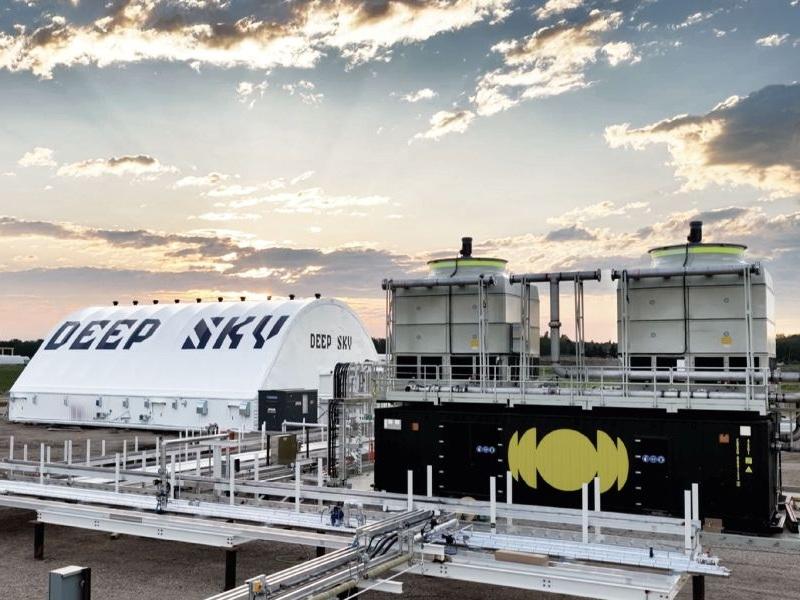
Deep Sky's projects include its Alpha site in Innisfail, Alta., where it hosts an array of DAC technology provided by companies around the world. It also has plans to run larger-scale projects in Manitoba and Quebec.
The TD agreement is not Deep Sky’s first with a Canadian bank. In 2024, the carbon removal company unveiled the first customers of its service, which included RBC.
Earlier this year, Deep Sky announced deals with Lufthansa Group and ENGIE to provide credits. For ENGIE, a French energy company, the agreement was for 15,000 carbon removal credits.
Outside of Canada, JPMorganChase signed deals to remove over 800,000 tonnes of CO2 from the atmosphere for US$200 million in 2023 from companies such as Climeworks and Charm Industrial.
Renzoni declined to disclose Deep Sky's number of credit sales to date.
"What excites me most about this agreement," he said, "is that it's a major Canadian institution directing that demand toward Canadian-built infrastructure." Demand for carbon removal committed today sets the stage for a much larger industry, Renzoni said.
TD’s carbon removal efforts
TD has been investing in carbon removal projects to reduce its residual CO2 emissions, it said, as it addresses its Scope 1 and 2 emissions. The bank has been securing carbon removal deals for years, such as signing an agreement with 1PointFive in 2023 for 27,500 tonnes of credits over four years.
In 2025, TD invested in carbon removal projects from Charm, Chestnut and Anew.
"TD's approach has always been to reduce first and remove what remains with the highest-quality solutions available," Nicole Vadori, vice president of global sustainability at TD, said.
Deep Sky “gives us a Canadian path to do just that; their development of diversified DAC technologies aligns with TD's approach to support a broad set of innovative clean technologies in North America."
Collaboration with partners like Deep Sky positions TD to “support clients as they integrate high-integrity carbon removal into their decarbonization strategies," Susan Thompson, managing director and head of global sustainable finance and advisory at TD Securities, said.
In its 2025 sustainability report, TD disclosed it had cut its Scope 1 and 2 emissions by 29 per cent from a 2019 baseline, going from 162,849 tonnes of CO2 to 116,197 tonnes. However, the two metrics are a fraction of the bank’s emissions from its supply chain and investments, known as Scope 3.



 Industry Events
 Locations