


 Locations

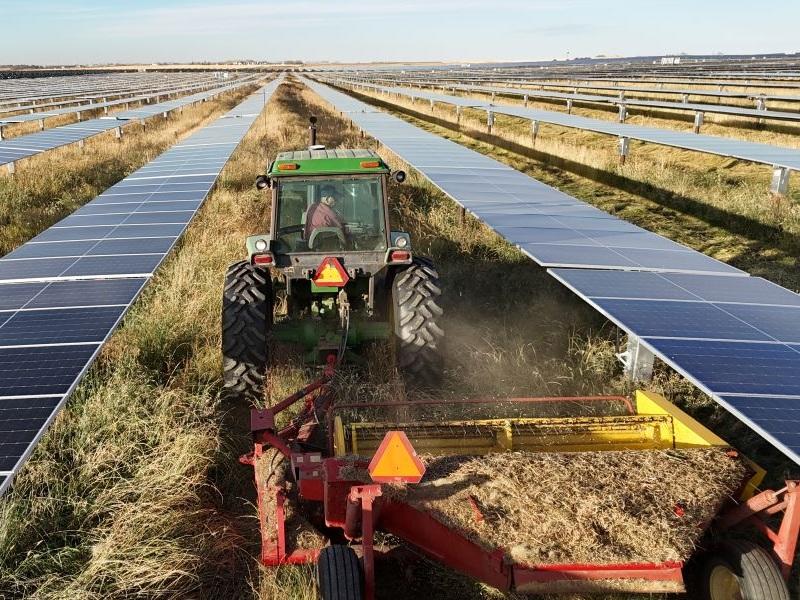


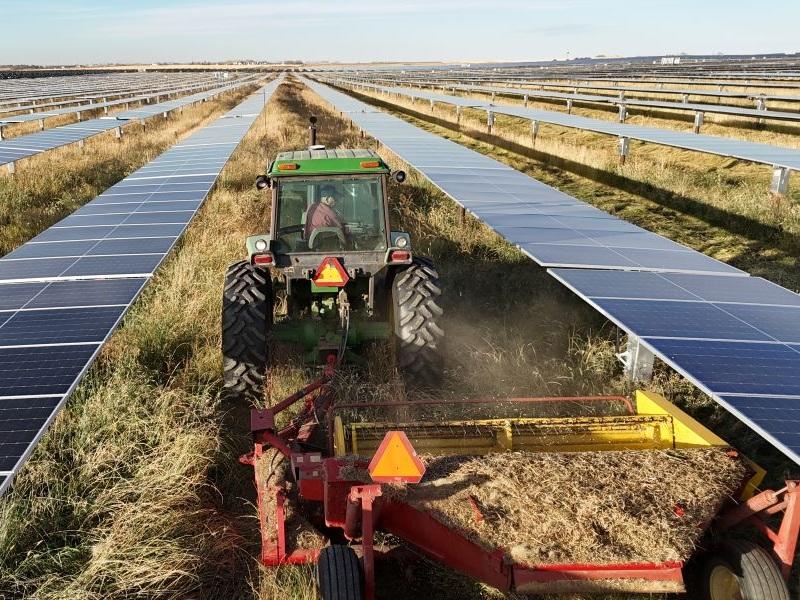
On 480 acres north of Calgary, General Land & Power is producing both hay and solar power in its Sollair Energy Project, showing how agriculture and renewable energy can coexist on the same plot of land.
Located approximately 50 kilometres north of Airdrie, Alta., Sollair is a 75-megawatt solar development that began operating in December 2024. It generates enough electricity to power approximately 23,000 Alberta homes.
Between the rows of solar panels, however, a tractor can be seen harvesting hay. Farther away, sheep graze under the shade of the panels.
Project developer General Land & Power, based in Calgary, took what was traditionally agricultural property and sought to “extract the most value from the land” while retaining its history, managing partner Mark Owerko said in an interview with Sustainable Biz Canada.
Despite the skepticism, Owerko said General Land & Power pressed forward on the project because “when people are telling you you can’t do something, it means that there’s something. There’s an opportunity there that nobody else had done this.”
Balancing clean energy and crops
The two industries Sollair brings together – renewable energy and agriculture – have sometimes been at odds over competing land uses, contributing to uncertainty about the project's development. Some in the agricultural industry have viewed renewable energy developments as competitors for fertile farmland, arguing that large-scale solar and wind projects take productive agricultural land out of use.
Alberta’s government has responded to concerns of sprawling renewables development squeezing out prime farmland. It set new rules that require an agricultural impact assessment for new wind and solar power projects on “high-quality agricultural land.”
General Land & Power was mindful of the resistance, Owerko said, and looked to “make sure that we were using the land in the best way that we could in the most efficient way we could.”
Buzz and baa
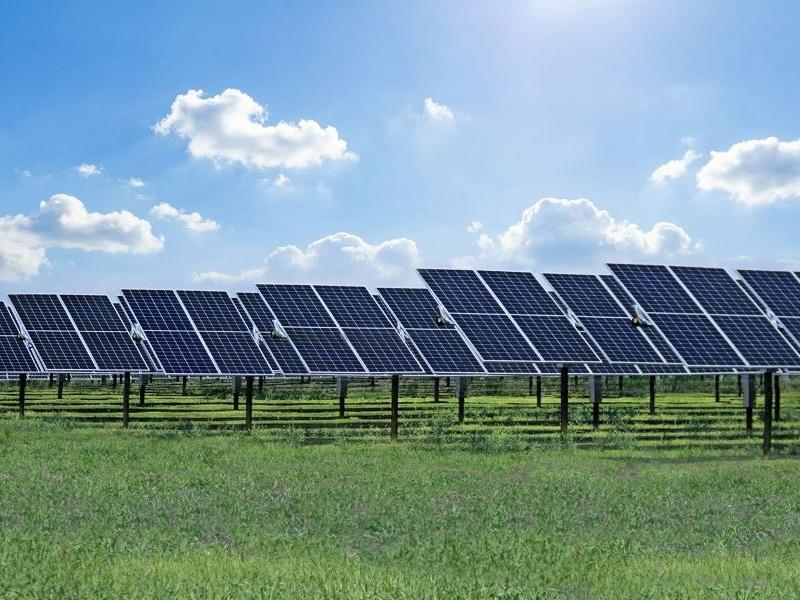
One way General Land & Power has maximized the site's agricultural potential is through solar tracking, which automatically adjusts panels to follow the sun. The technology also allows the panels to accommodate uneven terrain, Owerko said. If solar tracking was not used, General Land & Power would have had to strip all the topsoil and level out the earth to install fixed panels.
The approach limited soil disturbance to approximately 20 per cent of the site, leaving much of the land available for continued agricultural use, Owerko said.
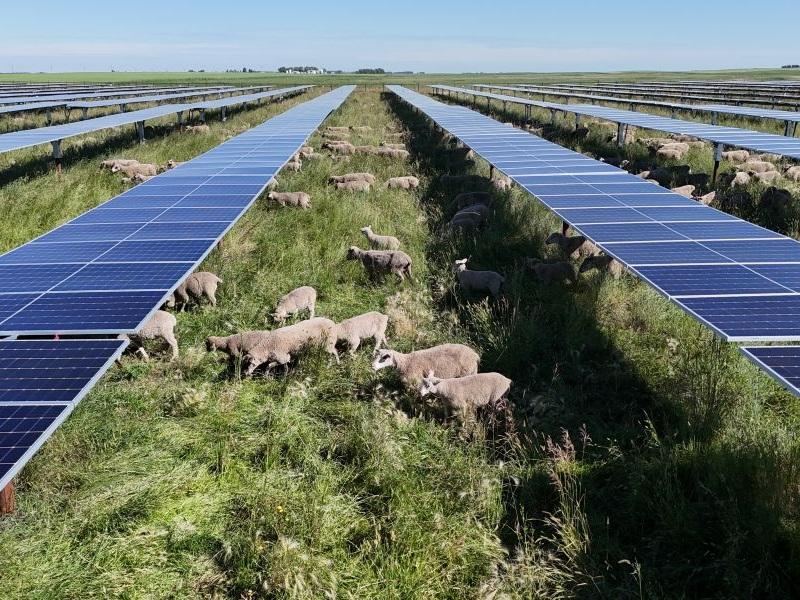
Sollair produced 250 bales of hay this year, and nearby farmers have expressed interest in purchasing the output, Owerko said. The company hopes to eventually grow higher-value crops such as barley and canola, further diversifying the property's agricultural output.
On a section of Sollair that cannot be cultivated, sheep can be found munching on grass around the panels. “They hang out underneath them, they hang out between them. There’s no adjustments,” Owerko said. The herd of 260 is owned by a neighbouring farmer and operates under a grazing lease.
The project also accommodates approximately two million honeybees, with a local beekeeper overseeing the hives. General Land & Power split half of the honey with the beekeeper, taking its portion for promotional treats and gifts.
Extracting maximum value
General Land & Power hopes Sollair will become a model for agrivoltaics, an approach that combines solar power generation with agricultural activities on the same land.
General Land & Power is working with Olds College and Red Deer Polytechnic to advance this research. Olds College is conducting soil studies and examining the benefits of sheep grazing beneath the solar panels, Owerko said. Red Deer Polytechnic, meanwhile, is exploring the possibility of establishing an agrivoltaics program. General Land & Power has opened the site to students and faculty from both institutions.
“Our objective is to try to see how much value we can extract out of the land,” Owerko said. “It’s so exciting to us to continually see the project evolve and change and sometimes defy expectations that people even have.”


 Industry Events
 Locations

