
 Locations






Climate tech industry funding commitments are trending higher and this bodes well for solution developers, according to industry experts at the MaRS Climate Impact conference.
“We’ve been tracking climate tech investment, and for the first time this year, it’s crossed $200 billion in cumulative investment since 2020,” according to Kim Zou, chief executive officer and co-founder of Sightline Climate, an intelligence platform firm, during a presentation at the event.
The company regularly tracks investment spending and through its CTVC newsletter, Zou said as she shared some recent findings at the event, held Dec. 2-3 in Toronto.
“For the first time in 2025 energy has overtaken transport as the leading vertical in climate tech investment. Despite climate tech investment overall declining 30, 40 per cent over the last couple years, energy investment has stayed relatively the same, and it now makes up almost 40 per cent of the overall climate tech investment stack.”
“So, a lot of focus, a lot of interest in clean power,” she said.
This trend was the “demand theme of the year,” she said, and highlighted the expected growth curve’s future pathway.
“In the U.S., load growth is expected to more than double over the next couple decades, every single year. This is an unprecedented amount and 55 per cent of electricity growth is coming from data centres. That is a key demand lever that is driving this investment.”
Stark contrast between China and the West
However, after a recent trip to China, the main competition for manufacturing revealed a stark contrast for Zou, when compared with the Western experience.
“If you go to Shenzhen or you go to Shanghai, you have your entire manufacturing ecosystem there: you could basically meet in a room of 20 of your suppliers the next day, if you wanted to . . . you can see the impact that these manufacturing ecosystems have had on China’s ability to deploy at scale.”
Zou pointed to Xiaomi as a company that began as a smartphone builder but has now launched an electric vehicle after only a few years of development. “It goes to show you the power of these convergence effects, when you have the players all right next to you and it’s really driving deployment faster than anywhere else,” she said.
But for firms looking to ramp up manufacturing, don’t ignore China’s experience.
“One of the key learnings is, rather than saying, ‘Let’s just build all this up from scratch and figure out how to do it.’ The reality is Western countries will need to partner with regions in China, in Asia; with companies who have developed that in-house process knowledge and bring that back to the west,” Zou said.
What investors get wrong
Joining Zou on stage was Nelson Switzer, managing partner and co-founder with Climate Innovation Capital who asked her what investors often get wrong.
“One of the fallacies of climate tech is that there’s been an assumption that demand will materialize because of net-zero . . . Unfortunately, it doesn’t seem like it’s going to play out,” Zou replied.
Complicating this is the way many companies look at such investments, which is known as an “energy trilemma,” Zou added.
“It’s not to say that environment doesn’t matter. It’s just that when it really comes down to it, when you look at countries, when you look at companies, it’s security first, affordability, and then environment.”
Climate impact awards
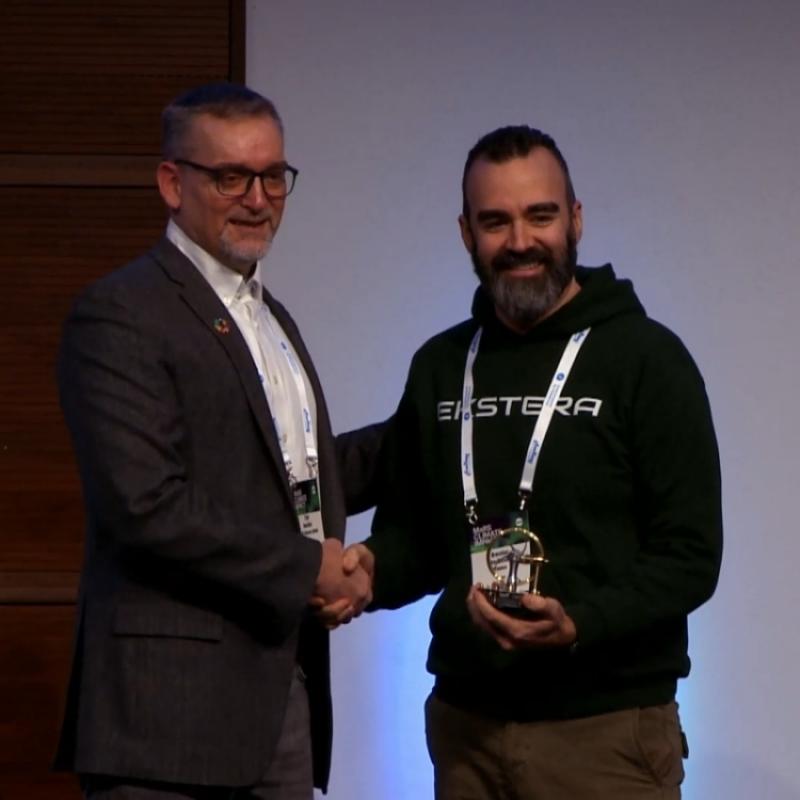
While the discussion gave attendees a picture of the funding environment, the conference also highlighted some success stories with its climate impact awards.
Brendan MacDonald of Toronto-based Ekstera won the MaRS Seed pitch award and Gillian Holcroft of Montreal's Green Graphite Technologies took home the MaRS Series A pitch award.
The decarbonizer award went to Mina Zarabian of Carbonova, based in Calgary.
“Concrete is the second most-used material in the world after water and a net zero future, whether it’s supporting clean electricity, low-carbon buildings or electrified transportation, all require concrete. A net zero future — literally and figuratively — rests on concrete,” award presenter Resha Watkins, a VP at St. Marys Cement, said.
The Reaction HUB Catalyzing Canada award was given to Aleisha Reese Cerny, CEO and co-founder of Serenity Power Inc, also based in Calgary.
Serenity Power makes solid oxide fuel cells but it needs seasoned help to bring it to market, she said.
“We know fuel cells really well but the commercialization and the scaling part of it is it feels like a big mountain to climb. There’s no book to this industry, so having support like that really goes a long way.”
The Canada Cleantech Alliance (CCTA) award was won by Jacqueline Peterson of Calgary-based Kathairos Solutions. The company received praise for its methane-reduction initiatives from Peter MacArthur, chair of CCTA, who presented the award.
“Geopolitical developments and apparent lack of progress in our net zero objectives can seem discouraging, but real progress is being made, as demonstrated in the successes that many of you are achieving,” he said.
Edward Chiang of B.C.-based Moment Energy won the Fasken Founder of the Year award.
“I pinch myself every day, from building batteries in half a garage to now we’re a team of 60 out in Coquitlam in Greater Vancouver . . . building, repurposing EV (electric vehicle) batteries into stationary storage, and now deploying them at YVR airport as well as hospitals all across British Columbia,” he said.



 Industry Events
 Locations