
 Locations





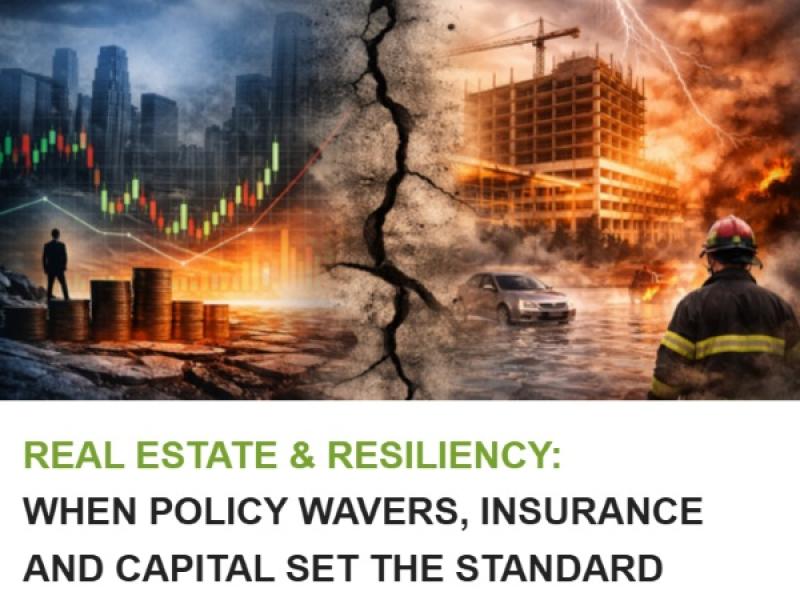
Despite waning policy influence on both sides of the Canada-U.S. border, the insurance sector remains fixated on climate risk, a ULI Toronto panel on real estate resilience said.
Held last week and titled Real Estate & Resiliency: When Policy Waivers, Insurance and Capital Set the Standard, the sustainable building organization assembled leading voices in the insurance and investment industries to argue that parts of the financial sector are holding strong on the climate, particularly resilience.
Facing rising losses due to extreme weather, which is forecast to be more frequent and stronger due to a warming climate, insurance company Tokio Marine Holdings acquired fellow Japanese company Integrated Design & Engineering Holdings Co., Ltd. (ID&E) to reduce its risk exposure. That brought Toronto-based BDP Quadrangle under the Tokio Marine fold.
The move “allows Tokio Marine to move upstream,” going from paying for damages to minimizing it, Alison Donato, panel member and senior vice-president of commercial lines in Tokio Marine Canada, said.
There is also likely to be more urgency in the home insurance sector around climate risk. MyChoice Financial, a Toronto-based insurance technology company, published a report that found insurance costs are rising faster in areas of high risk for flooding in Ontario.
Climate resiliency a "long game"
Panel moderator Luka Matutinovic, the co-founder and principal of Toronto-based Purpose Building, asked Donato why Tokio Marine acquired ID&E and why it sees resilience as core to its growth.
The transaction gave Tokio Marine the in-house engineering capabilities it lacked for disaster prevention and mitigation, infrastructure resilience, urban development, and decarbonization, she answered. Tokio Marine on the other hand has the insurance loss data. Bringing the firms together added new capabilities which complement its insurance business in the long-term, Donato said.
Combining both skillsets means Tokio Marine is better equipped for tasks such as identifying risks, designing assets to mitigate losses, and enhancing the resiliency of buildings after losses, she continued.
Matutinovic followed up with a question about the value creation from the acquisition. Donato replied “resiliency is a long game,” and the business models of both companies are centred around the long-term in a changing world.
“It sets a new North Star for us. It clearly says resilience, long-term planning – that’s one of the fundamental goals,” Michelle Xuereb, the Toronto-based innovation director for BDP Quadrangle in the Americas, said about the acquisition.
It added a deeper purpose to BDP’s sustainability initiatives, she said, and normalized those practices on its projects such as prioritizing climate risk discussions with its clients. As part of a much larger company, BDP has access to more disciplines, Xuereb said, opening doors to different sectors and work at larger scales.
“It brings us upstream to be having conversations with cities,” she said.
How resilience helps communities
Matutinovic referred to historic weather-related losses in Canada ($8.5 billion in 2024 for example), and asked Donato what have been the biggest changes in how insurers are underwriting property risk in recent years.
The insurance industry is increasingly supporting its clients in adding resilience during construction, Donato said. Measures include water detection systems, green certifications and using sustainable building materials. After the building is finished, it could mean encouraging the pursuit of more certifications.
She has seen more clients taking climate risk mitigation seriously. As insurers, it is Tokio Marine’s responsibility to educate clients about the importance of sustainability, Donato said.
Investing in resilience means more vibrant communities, Xuereb noted. “We’re realizing that there is true value in doing this. If you have a community or a city or a building that prospers, then you also attract investment.”
Flood risk already impacting housing markets in Ontario
The insights from the panel align with the global insurance industry sounding the alarm bells about the elevated risks from climate change and how it could alter its business model.
One such company is MyChoice. A report from last week found flood exposure is being reflected in home insurance premiums in Ontario. Higher-risk areas are seeing faster increases in insurance costs, even as home prices have fallen and mortgage rates have eased.
“While homes may be cheaper to buy, they are becoming more expensive to own,” MyChoice said.
For the report, MyChoice partnered with Wahi, a real estate technology company it collaborated with on a similar report last year about wildfire risk. MyChoice analyzed home insurance premiums in 39 Ontario cities and municipalities, and compared how it changed between 2024 and 2026.
In higher-priced markets, rising insurance costs were diluted by home values, MyChoice found. But in more affordable markets, particularly those with higher flood risk, there were signs insurance is taking a “significantly larger share of monthly housing costs.”
Ajax, the highest flood-risk city, saw premiums rise 26 per cent, going from $1,022 to $1,290. The highest home insurance inflation was in Thunder Bay at 31 per cent, a city with medium-level flood risk.
Cities with high flood risk – Ottawa, Mississauga, Toronto – recorded steady premium increases ranging from 12 to 18 per cent.
If insurance costs continue to rise, particularly in higher-risk areas, it may begin to influence where Canadians choose to buy homes, MyChoice said.
In light of the situation, the Canadian government released its Flood Risk Finder earlier this week, a public source of data for flood hazard and risk. Users can search for the flood risk in their area to better prepare against the threat.


 Industry Events
 Locations