Locations






 LAZ Parking plans to add thousands of electric vehicle (EV) charging stations across its Canadian locations over the next five to seven years, a strategy that will include software made by its partner Epic Charging.
Announced last December, LAZ intends to install between 3,000 and 5,000 charging stations in Canada and 45,000 to 47,000 in the U.S. Epic is the preferred software vendor for LAZ in the project, providing technology that supplies operational data such as the number of EVs being charged per day.
Employing Epic's technology “is essentially allowing us to scale much quicker,” Nathan Donnell, senior director of EV partnerships at LAZ Parking, said in an interview with Sustainable Biz Canada.
Headquartered in Hartford, Conn., LAZ is one of the largest privately owned parking operators in North America. It manages and operates over 300,000 spaces in Canada and approximately 1.8 million in the U.S. The company services properties such as BC Place and the Rogers Arena in Vancouver. Last year, it acquired a majority stake in INDIGO Park Canada Inc.
Today, the company has approximately 1,600 EV charging ports in Canada and almost 10,000 in the U.S., Donnell said.
LAZ's EV charger rollout
LAZ invested into EV charging because of the increasing adoption of battery-powered cars.
“As more and more EVs are being sold and in the market, there are needs to charge those,” Donnell said. The equipment also helps drive traffic to properties, he said, increasing revenues for its clients.
While new zero-emission vehicle registrations in Canada declined by 40.1 per cent in Q3 2025 compared to Q3 2024, Electric Autonomy reported it was still up slightly from Q2 2025.
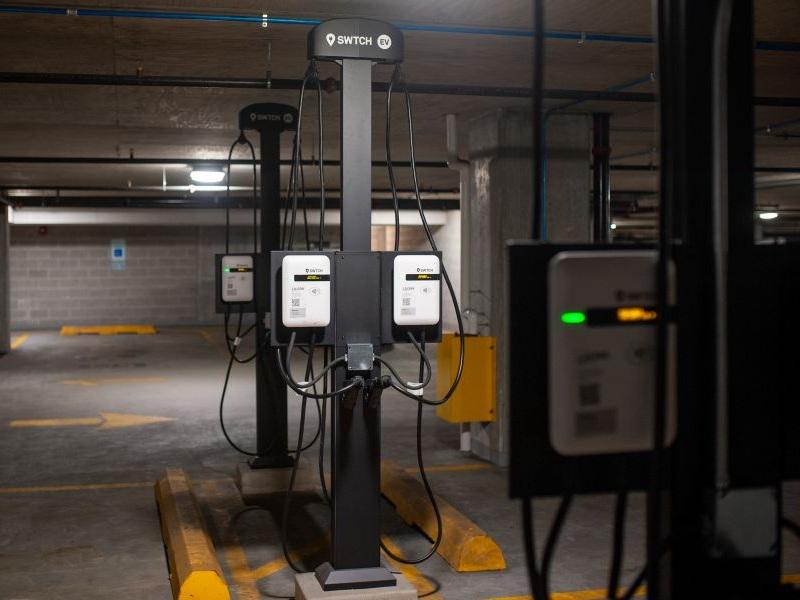
The chargers, which will be mostly Level 2 and some Level 3, will be installed in parking spots for hotels, health care buildings, mixed-use properties, municipalities, universities and airports. LAZ purchases its Level 2 chargers from Autel as a preferred vendor, Donnell said.
As the average parking stay at LAZ-managed spots is approximately three hours, the company focused on Level 2 chargers because the equipment provides the most “cost-effective way to get EV charging in those locations,” Donnell explained. Plus, some properties do not have the electricity capacity for the more powerful, rapid Level 3 chargers.
In addition to expanding its EV charging capacity, LAZ will also install some of the new chargers in parking spots that have out-of-date EV chargers or units no longer supported by their manufacturer. The company also aims to tap into government incentives and programs that support the installation of the equipment.
Epic's role in the strategy
Critical to the partnership is Epic’s software. Epic is a Menlo Park, Calif.–based EV charging software provider. Its products are used by vehicle fleet managers, businesses and municipalities across North America. As part of the partnership, LAZ invested into Epic and became a shareholder.
Epic’s charge point management system monitors EV chargers, performs predictive maintenance and automates payments. The data acquired by the software will inform LAZ’s business intelligence team and revenue reporting, assisting its growth, Donnell said.
Epic will also play a role in balancing the energy demand from the chargers. Charging equipment can stretch the limits of a building’s electricity capacity if used widely, increasing the risk of brownouts. To address the problem, LAZ offers several options.
If a location has a capacity limit, Epic’s software can stretch the remaining power out evenly across the chargers as a form of load balancing, Donnell explained. Backups such as battery storage and powering the chargers with natural gas, solar energy and propane could also be in place.
To advance innovation in the sector, LAZ’s investment into Epic will support development of Charge OptimAIzer. An artificial intelligence-powered software, it will analyze real-time data from the vehicles, chargers and utility pricing signals to balance loads and reduce costs of charging.


 Industry Events
 Locations