Locations






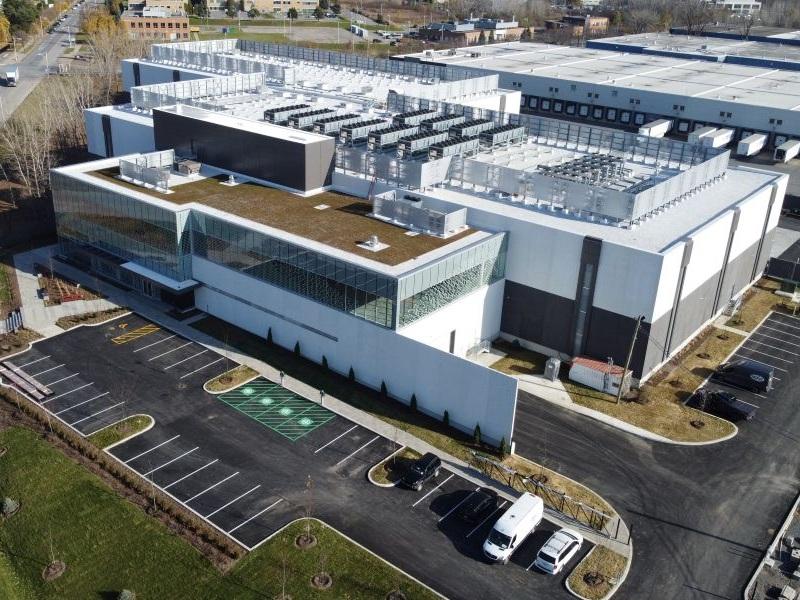
As Cologix’s first LEED Gold-certified data centre, MTL8 in Montreal will serve as an example for the company as it works toward more efficient and low-carbon operations, the company's top environmental, social and governance strategy officer said.
The 206,000-square-foot facility outperforms the average energy efficiency of the Denver-headquartered company’s portfolio. It is powered by Quebec’s electricity grid, which is almost entirely generated by renewable energy sources. A green roof is in place to reduce the heating and cooling burden of the data centre.
The global growth of the internet and artificial intelligence services has fuelled a boom in data centre development. But the facilities demand large amounts of energy and resources to operate, leading to concerns over environmental impacts such as the resulting carbon emissions and fresh water consumption.
Mindful of such issues, MTL8 was “conceived and built with environmental stewardship at its core,” Page Haun, who also serves as Cologix's chief marketing officer, said in an interview with Sustainable Biz Canada.
“The huge learnings that we’ve had from building MTL8 — being able to apply those to all of our builds going forward, that’s going to be a needle mover for us,” she said.
Cologix operates 46 data centres in Canada and the U.S. Half of its data centres are in Canada, located in Montreal, Toronto, Vancouver and Calgary. The company’s cloud computing onramps available to clients at MTL8 include the platforms of Amazon, Google, IBM, Oracle and Microsoft.
Timeline, details of MTL8
Construction on the data centre began in the spring of 2023; operations started in the summer of 2025. MTL8 is one of Cologix’s larger data centres, capable of outputting over 21 megawatts of computing capacity. It is designed to serve interconnection and hyperscale customers.
LEED Gold is the second-highest standard behind Platinum, measuring buildings for performance on factors such as energy performance, building materials and construction waste management.
Cologix prioritized achieving the standard for MTL8 because the company felt it was mature enough to aspire for such a certificate, Haun explained. As the first property Cologix aimed to certify under LEED standards, the company applied different methodologies for cooling and site management at MTL8, she said.
“This is the right time for us to take that significant step and invest in our learning for all our sustainability practices.”
With the use of innovative HVAC and cooling systems, plus the insulation provided by a green roof, MTL8 is designed to hit a power usage effectiveness (PUE) ratio of 1.3 or lower. In 2024, the PUE average of Cologix’s portfolio was almost 1.5, according to its latest sustainability report.
The green roof filters pollutants from the rainwater. It also protects the roofing membrane from ultraviolet rays, doubling or tripling the lifespan of the roof, Haun said.
For the construction of MTL8, Cologix chose locally sourced materials and suppliers to minimize the carbon emissions from transportation and shipping, and followed waste management principles aligned with LEED.
The investments into sustainability will generate efficiencies in water and energy use, Haun said, cutting operational costs. Additionally, it will help attract and retain Cologix’s customers and employees, she added.
The innovations Cologix used for MTL8 will be applied to future data centres, Haun said.
Cologix’s work in sustainability
As for Cologix’s overall portfolio, the company reported using carbon-free energy for 65 per cent of its needs in its latest sustainability report, a decrease from 68 per cent in 2023.
Haun noted Cologix’s portfolio grew significantly from 2023 to 2024, increasing from 1.9 million square feet under management to almost 2.7 million square feet. Despite that, it kept its Scope 1 and 2 emissions intensity flat over the period. Cologix also reported a small decrease in its Scope 3 emissions – falling by approximately two per cent from 2023 to 2024.
To keep its Scope 1 and 2 emissions intensity unchanged, Cologix took steps such as using a mostly clean energy mix and controlling the number of generator runs. To address its Scope 3 emissions, Haun said Cologix used more sustainable materials and worked with its suppliers.
Cologix will continue to focus on powering its data centres with renewable energy and addressing its water and energy use intensity, Haun said. Its 2030 environmental targets are having all of its facilities powered by renewable energy and halving Scope 3 carbon emissions.


 Industry Events
 Locations