Locations








GUEST SUBMISSION: While the concept of local power has been gathering support and investment for many years, it has arguably reached an historic milestone with the U.K.’s newly announced Local Power Plan (LPP).
A range of new business ventures directly and indirectly related to these energy facilities are likely in the offing.
Backed by up to £1 billion ($1.85 billion) of funding from Great British Energy (GBE), the LPP is the largest public investment in community energy in British history, and in this respect among the most ambitious community power initiatives of all time.
What is community energy?
Community energy is typically defined as power generation and related energy facilities designed primarily for the benefit of their local or host community. Community energy projects are typically owned by people and companies located near the installation, and their output, despite being grid-connected, is intended to be largely used locally.
Community power is attracting interest in part because, when properly designed and operated, it can provide significant savings and other benefits to both the local community and the broader electric power system, while enabling its host communities to exercise greater control over infrastructure development in their region.
In recent years most community power has focused on renewable energy and low-impact forms of generation, further enhancing its appeal.
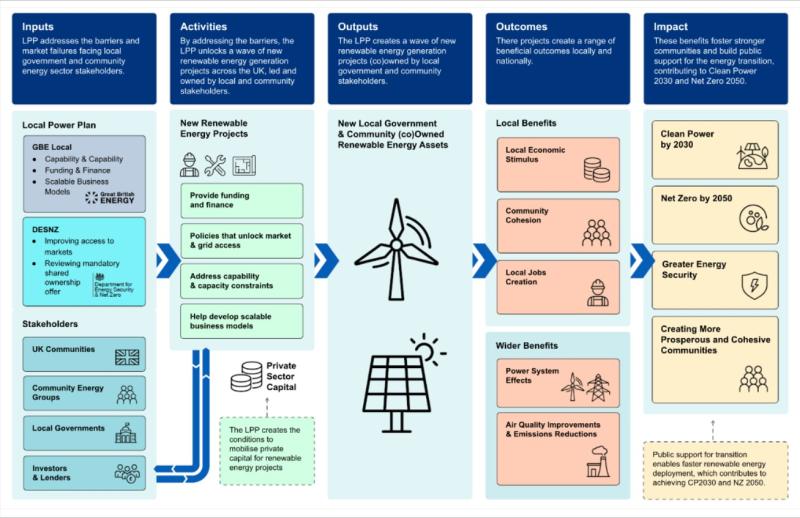
Overview of the U.K.’s recently announced Local Power Plan. Source: UK Department for Energy Security and Net Zero (Courtesy U.K. Department for Energy Security and Net Zero)
Although the LPP was formally announced on Feb. 11, considering the extensive range of structural details laid out in the announcement, it’s clear the idea has been under development within the British government for some time.
Brought forward under the U.K.'s Department for Energy Security and Net Zero (DESNZ), its aims include “driving forward a sea change in support for community ownership.” Officials are promising to “tackle policy and regulatory barriers to create an environment for local energy projects to grow and thrive.”
Potential impact of the plan
Although the plan does not define specific targets for the amount of new generation to be brought online, if industry norms persist, the plan could lead to hundreds of megawatts of new generation capacity in the U.K. (Any such estimate is only a rough approximation, indicative of the expected order of magnitude only, as much remains to be determined about the nature of the investments under the LPP.)
The announcement comes with an invitation to community organizations across the country to bring forward proposals, either on their own or in collaboration with private sector entrepreneurs. The Plan is intended to form part of a broader energy policy designed to ensure that future energy project developments maximize benefits to the communities in which they operate.
The Plan is also being designed to work in collaboration with local power distributors, known in the U.K. as Distribution Network Operators, to “serve the needs of the energy system and harness the value of flexibility and a smarter system.”
To stimulate early investigations, GBE is launching an Expression of Interest process inviting communities and local governments to share their project ideas “so we can understand their readiness and suitability for the Local Power Plan, and whether they might need future support or investment.”
The agency explains that it is open to considering a number of models for “shared ownership” including:
- Split ownership: In which the community owns a physical portion of the project.
- Joint venture: In which a community group and a developer co-own a special purpose vehicle.
- Shared revenue: In which the local community retains rights to a share of the project’s future revenue.
The public funding is intended for renewable power facilities like solar, onshore wind and hydro.
The announcement explains that “full details, including GBE’s investment allocation, will be published in the GBE Capital Toolkit expected in Autumn 2026." GBE notes that it will launch a Local Investment Fund, “searching on a project-by-project basis to identify viable investment opportunities and provide direct investment into local projects.”
Key elements of the initiative will include:
- Making the grid connection process and experience easier.
- Helping communities access battery power.
- Making the planning system work for communities and support community energy projects in England.
- Unlocking the potential of “Smart Community Energy.”
- Continuing work with Ofgem and Elexon on key code modifications P441, P442, P444 and P415 to make it easier to establish local energy communities, share locally generated power and benefit from community energy.
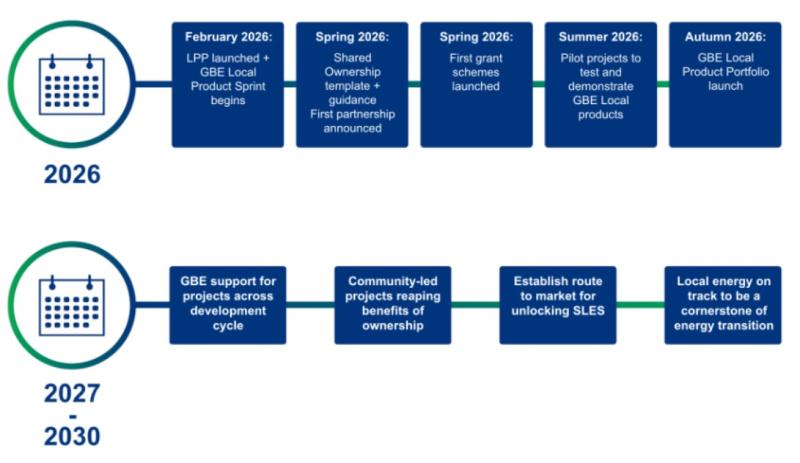
Anticipated timeline, from the U.K. government announcement on the Local Power Plan, Feb. 11, 2026. (Courtesy U.K. Department for Energy Security and Net Zero)
Support for community-based energy initiatives is expected to be available in four forms:
- Support Type 1: Direct funding and finance for projects.
- Support Type 2: Capacity and capability building through expert advice and support.
- Support Type 3: A long-term plan to unlock wider investment in community and local energy.
- Support Type 4: Policy and regulatory changes.
Implications for Canada
Ontario has also made significant strides toward the development of community power, but its efforts take a different approach, relying largely on market mechanisms with little direct financial support from government.
Nonetheless, the examples of and experiences from the structures and mechanisms being planned in the U.K. will likely be instructive for Ontario and other jurisdictions as they develop their own approaches and programs.
As a result of its Plan, the U.K. is likely to join a list of countries demonstrating international leadership in community power. Large amounts of community power are installed and operating in the United States, Germany, Denmark and others.
No doubt the character and net results of the LPP will depend greatly on the kinds of projects and proposals that come forward from communities across the U.K. in the years ahead. But there is little doubt this initiative will be a major step forward for community-based power, with reverberations well beyond the U.K.



 Industry Events
 Locations