


 Locations








Nouveau Monde Graphite Inc. (NMG) has developed a coating for battery anode materials that could eliminate over 100 kilograms of carbon dioxide emissions per tonne of coated graphite, offering battery manufacturers a lower-carbon alternative to petroleum-based materials.
The Saint-Michel-des-Saints, Que.-headquartered company (NOU-T) developed the coating in collaboration with a McGill University team led by Philippe Ouzilleau, an assistant professor specializing in carbon-based materials processing. The anode material coating helps maintain the electrochemical properties of graphite, such as capacity and first-charge efficiency, Boulanger explained.
Based on a biomass-derived product as opposed to the pitch made by processing petroleum, the coating is estimated to eliminate up to 130 kilograms of carbon dioxide per tonne of coated spherical purified graphite, which is used to manufacture anodes.
Replacing petroleum-based pitch with a biomass-derived coating reduces emissions associated with anode material production by eliminating the need to manufacture pitch, a highly energy- and carbon-intensive material.
The coating advances the company’s effort to develop “the lowest-carbon-footprint natural graphite product that goes in a lithium-ion battery anode,” Patrice Boulanger, NMG's vice-president of sales, marketing and business development, said in an interview with Sustainable Biz Canada.
Developing a sustainable anode material coating
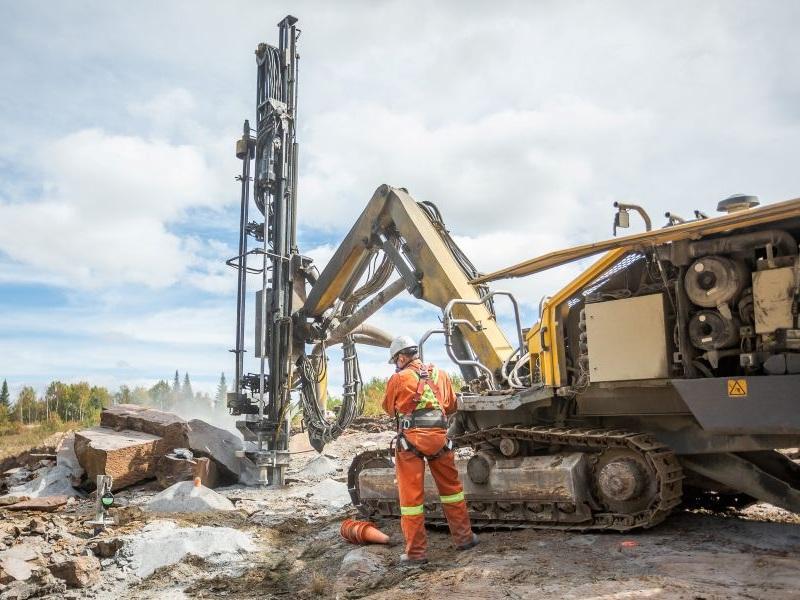
NMG is developing a graphite mine in Matawinie and an anode material factory in Becancour, both in Quebec. To reduce its environmental impact, NMG plans to power its operations with renewable electricity.
NMG and McGill University partnered up in 2020 to develop environmentally friendly battery material technologies. Ouzilleau investigated whether certain types of biomass could replace petroleum-based pitch, which would “mimic what the petroleum pitch would do once it’s processed on graphite particles,” Boulanger said.
Boulanger declined to disclose details of the coating’s production because NMG has filed a patent application. He said the process involves refining readily available, affordable biomass into a coating for microscopic spheres of purified graphite that NMG aims to produce. The graphite would then be used to make anode materials.
For now, the projected carbon emission reductions from NMG’s coating accounts for only the direct pollution known as Scope 1. The company opted to keep its calculation to only Scope 1 because it looks to secure a patent quickly, Boulanger said, while considering additional emissions would add more time to that process.
NMG plans to calculate the emissions from electricity use and the supply chain when the company’s internal process and value chain is better understood, he added.
An ‘attractive solution’
Tests on the biomass-derived coating conducted according to an unnamed battery cell manufacturer’s protocol have shown capacity, first-cycle efficiency and fast charging in line with a pitch-based material, NMG said. To further assess the coating’s commercial potential, NMG plans to conduct comparative long-term cycling tests, examine the potential of new material types and run a campaign on industrial-scale equipment.
NMG has commercial exclusivity for future use of the coating, and plans to reserve initial use for itself. But if commercialized, the company plans to offer the coating as an option to its graphite customers, such as battery cell manufacturers.
“Those who have a higher or greater interest in reducing (their) carbon footprint, this could be an attractive solution,” Boulanger said.
For companies selling into Europe, the coating could offer a competitive advantage as the European Union’s Carbon Border Adjustment Mechanism puts a price on emissions associated with certain carbon-intensive imports. Other companies may be enticed as it would disconnect them from the petroleum industry and secure more reliable sourcing, Boulanger said.
NMG’s anode material coating is expected to be cost competitive with pitch, he added.
The company plans to further refine the coating to improve the anode’s electrochemical performance and reduce its carbon footprint, Boulanger said.


 Industry Events
 Locations

