Locations






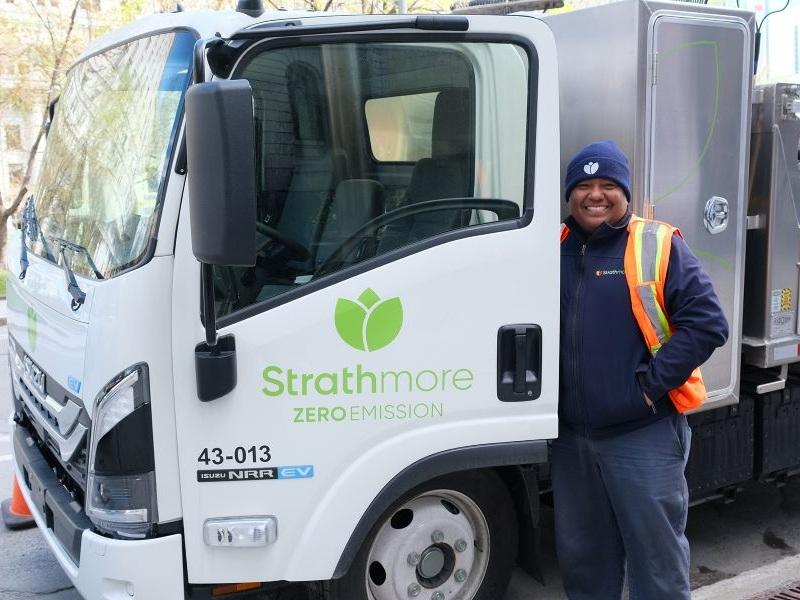
The ongoing transition to an electric fleet has led to happier employees and clients for Montreal-based Strathmore Commercial Landscape Management. But it has also demanded a rethinking of its operations, including how to contend with the challenges of winter weather.
Driven by a zero-emissions policy it initiated in 2011, Strathmore has taken steps to owning a fleet that is 50 per cent electric across its light- and medium-duty vehicles by 2030 and 80 per cent overall by 2040.
Since then, it has built up a fleet of 12 electric vehicles (EVs) such as Isuzu dump trucks, a MAX-EV LSV Electric Utility Vehicle and e-bikes. By June 30, Strathmore expects to have a fleet that is 10 per cent battery-powered.
Strathmore launched three zero-emission crews in Montreal and Ottawa in 2025. The employees drive electric trucks and use battery-powered hand tools such as blowers and chainsaws.
“If companies and contractors aren’t buying it, then manufacturers won’t keep producing and pushing themselves to get better,” Strathmore’s president Jessica Milligan said in an interview with Sustainable Biz Canada.
"It’s better for the future"
Operating in Canada and the U.S., Strathmore counts Broccolini, CBRE, Amazon and Cadillac Fairview among its clients.
The performance of the EVs has been “excellent,” Milligan said. Most of Strathmore’s clients are satisfied with the EVs because they better align with their sustainability goals, she explained, while not demanding any change to client behaviour or infrastructure.
The drivers on Strathmore’s landscaping teams often do need to learn how to manage an EV, such as learning to use regenerative braking to maximize battery life. But after five days of getting behind the wheel of an EV, most of Strathmore’s drivers prefer the battery-powered option, Milligan said.
To instill personal engagement and a more successful EV transition, Strathmore has encouraged the selection of crew leaders who want to drive an EV. Strathmore’s employees have been drawn to EVs, knowing “that it’s better technology, it’s better for the future,” Milligan said.
Electrification does come with an upfront premium, she noted, with EVs costing between 20 to 40 per cent more than their fossil fuel-powered counterparts. But the value proposition has only increased with the volatility of fuel prices, Milligan noted.
Infrastructure, batteries, licensing
While offering several advantages, building up an EV fleet opened new areas to address and challenges to overcome for Strathmore to achieve its most ambitious targets for electrification.
Getting enough power and electricity management into Strathmore’s older buildings to accommodate charging infrastructure was one. The company has worked with Hydro-Quebec and specialized contractors to build the electrical capacity for its EV fleet, Milligan said.
“That’s obviously quite expensive to do. So there’s a critical mass that’s important to reach to justify those expenses.”
Another important issue is the weight of the batteries. If Strathmore wants to extend the range of its EVs, that would mean installing heavier batteries and thus elevating the vehicles to a different weight class. Strathmore would need its drivers to earn a truck driver’s license when a gas-powered equivalent would only require a general license to operate.
The battery limitation has forced Strathmore to keep its EVs on routes of 120 kilometres or less, far less than an internal combustion engine vehicle. Strathmore has managed the problem so far by optimizing its routes, Milligan said.
The company hopes to have productive talks with Quebec’s vehicle and driver licensing agency this summer to change licensing standards around EVs and weight classes.
Breaching the winter barrier
The biggest challenge to overcome on its road to fleet electrification is winter operations, Milligan said. Cold temperatures drain batteries faster than average and the strain of handling snow adds further pressure on the vehicles.
“We’re starting to see now that there’s technologies that we could start pilot projects with in the winter. But we’re just not nearly as advanced in terms of winter operations,” Milligan said. “So we really focus it for our summer operations.”
She would like to see manufacturers build powerful EVs that can handle snow removal such as wheel loaders. If the winter limitation is solved, more landscapers can embrace the EV transition, Milligan believes.
“We’re just continuously proving the concept, getting more and more people engaged in adopting zero-emission technologies,” she said.


 Industry Events
 Locations