
 Locations







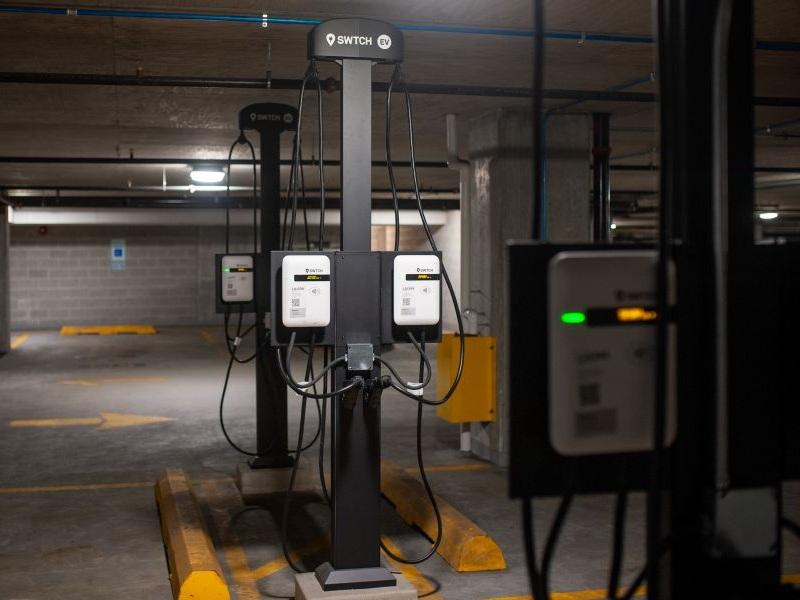
A partnership that has resulted in the rollout of 1,000 of SWTCH Energy Inc.'s electric vehicle (EV) chargers in 85 residential communities managed by FirstService Residential creates a compelling incentive for the properties, the two Canadian companies believe.
The collaboration between Toronto-based SWTCH and Mississauga's FirstService Residential started in 2020. Over half of the chargers and three-fourths of the communities are in Canada, Jeremy Cohen, director of real estate partnerships at SWTCH, said in an interview with Sustainable Biz Canada.
SWTCH partners with EV charger manufacturers to install its software that provides services such as managing a building’s electricity capacity for EV charging and sending relevant data such as revenue generation to the property manager. The chargers are used in multiresidential, commercial, office, retail, mixed-use and hospitality properties.
FirstService Residential is the property management business of Toronto-based FirstService Corporation, managing approximately 9,000 residential communities in the U.S. and Canada. Approximately 10 per cent of its communities are in Canada.
FirstService Residential “is just a perfect example of a real estate organization that’s trying to do right by the residents and the communities that they serve,” Cohen said about its partner.
The SWTCH-FirstService Residential partnership
The partnership between the two companies covers properties in Ontario and British Columbia in Canada, and New York, New Jersey, Tennessee and Florida in the U.S. Examples of serviced communities include 66 chargers at Shannon Wall Centre Kerrisdale in British Columbia, and the Atrium II condo in Toronto with 21 chargers.
Almost all of the Level 2 chargers in the partnership are made by Taiwanese company LITEON Technology.
EV chargers are a highly in-demand amenity for multiresidential buildings, Cohen explained, as the infrastructure attracts and retains residents who are driving or considering an EV.
Even some residents who do not own an electric car have installed a charger in their parking spot, Rob Detta Colli, a director at FirstService Energy, said in an interview with Sustainable Biz Canada. FirstService Energy is an affiliate energy advisory of FirstService Corporation.
Having a charger opens up the resident to owning an EV in the future or advertising the unit as being EV-ready, he explained.
SWTCH’s dynamic load management software stood out to FirstService Residential, Detta Colli said. It allows FirstService Residential’s management teams to get a picture of a building’s electricity capacity and control the amount of power going to the EV chargers. For example, when most residents are asleep at night and electricity capacity is freed up, more power will flow to the chargers.
As buildings have limited electricity capacity, being able to regulate the power going to the chargers “is the most important thing to keep flexibility for that building in the future to maintain electrical capacity,” Detta Colli said.
SWTCH’s software allows building managers to include EV chargers in older buildings that were not constructed to accommodate such hardware, saving money on “enormous infrastructure upgrades,” Cohen said. At the Shannon Wall Centre, SWTCH helped its management save $1 million in infrastructure upgrades, he said.
'Our business model is built on private investment'

Cohen said SWTCH has partnerships with other real estate companies such as Vancouver-based Onni Group and U.S. companies Greystar and Time Equities Inc. In Canada and the U.S. the company maintains a network of over 25,000 EV chargers, approximately half in each country.
To promote EV charger adoption, FirstService Residential operates a program to guide clients through key questions and concerns around the equipment.
The EV sector in Canada and the U.S. has hit road bumps with sales mandates and federal incentives being scaled back or cancelled, plus plans for major factories getting axed or delayed. But Cohen is not too worried for his company.
“The EV industry has its highs and its lows — sometimes highly politicized and tumultuous if you read some of the headlines,” he said. “But it’s really not the case because our business model is built on private investment.”
SWTCH will be proactive in identifying future markets, Cohen said. He listed British Columbia, Alberta, Oregon, Washington and California as particularly enticing jurisdictions because of provincial and state incentives. The SWTCH-FirstService Residential partnership is already being expanded to Alberta, for example.
SWTCH will remain focused on enhancing its software, such as ensuring chargers are connected to the its network in underground parking spaces where connections can be spotty, Cohen said.


 Industry Events
 Locations