Locations




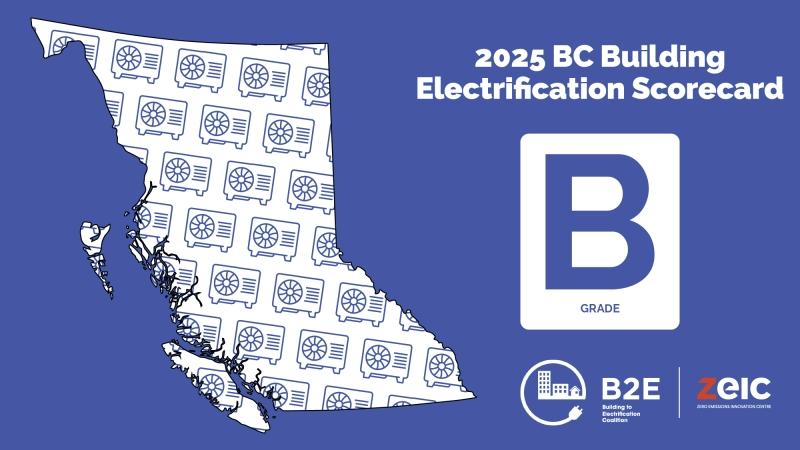
British Columbia has received a B grade from the Building to Electrification Coalition for progress in 2025 to move buildings away from fossil fuels. The grade reflects positive government policies and adoption of new technologies, but is impacted by unclear regulations.
A program of the Vancouver-based non-profit Zero Emissions Innovation Centre, the coalition noted the improvement from 2024 was driven in large part by BC Hydro having a clearer pricing system, as well as the heat pump industry phasing out strong greenhouse gases from refrigerants.
On the other hand, the “uneven implementation” of the province’s climate plan, CleanBC, is said to be “creating uncertainty for industry and barriers for electrification.” The end of the consumer carbon tax last year diminished a major incentive for cleaner energy.
“There are a lot of policies that have been adopted since that first scorecard was launched,” Mariko Michasiw, the program manager of the Building to Electrification Coalition, said in an interview with Sustainable Biz Canada. “We wanted to be able to demonstrate that progress has been made without saying that we’ve fully achieved it.”
The coalition, founded in 2021, is a network of over 250 member organizations made up of the buildings industry, governments and non-profits. Its founding members are BC Hydro, the City of Vancouver and the Zero Emissions Building Exchange.
Just under 20 per cent of British Columbia’s greenhouse gas emissions were related to buildings in 2023, the latest year inventoried by the province. British Columbia has set a 2030 target of reducing greenhouse gas emissions from buildings and communities by more than half against 2007 levels.
How B.C. is doing on building electrification
Building to Electrification Coalition’s annual score cards track progress on recommendations in the BC Building Electrification Road Map, a strategy released in 2021 to push the province’s buildings away from consuming fossil fuels to using electricity in a province with a low-carbon grid.
The score cards track the status of 26 actions with grades from one to five, with one being no coordinated activity and five being full implementation.
Since the first score card in 2022, British Columbia has seen “significant progress,” Michasiw said. Most of the actions “were starting at either no implementation or partial implementation,” and now “some of them have moved to full implementation.” In 2025, most of the action scores were deemed a four, compared to merely one score of four in 2021.
Since 2021, the Zero Carbon Step Code has been adopted by over 30 municipalities in British Columbia, Michasiw said, which represents over half of the province’s new building starts.
There has been a greater emphasis on offering training opportunities for contractors, installers and designers since the score cards were released, she said, such as courses on installing heat pumps.
Another factor has been a raft of policies supportive of building electrification, such as CleanBC establishing financial incentives scaled by income like the Energy Savings Program.
Progress, slides in 2025

The latest score card is the first to be reported under a letter grade, Michasiw said. If the progress in 2024 was measured similarly, it would have been graded a B-minus, she added.
From 2024 to 2025, BC Hydro’s changes to its distribution extension policy were approved. The move, which raised the corresponding score from three to five, means more predictable costs for consumers when applying for a service upgrade, Michasiw said.
Another positive step was increased adoption of technologies made with refrigerants that have lower global warming potential compared those previously used in the sector. The Kigali Amendment, which mandates phasing-out the chemicals which are highly potent at trapping heat in the atmosphere, has led heat pump manufacturers to use refrigerants with less global warming potential, Michasiw said. It raised the relevant score from three to four.
But a sharp hit to the overall grade came from the phase-out of the consumer carbon tax in 2025. The change has made natural gas cheaper, she said, making it harder for consumers to disconnect from a connection unless they have a strong interest in sustainability.
Another stumbling block to greater progress is the stalled Zero Carbon Step Code, Michasiw said. British Columbia’s government has not yet established a timeline for its next steps, she added, so clearer communication and setting a timeline would be helpful.
To raise its grade from a B, British Columbia should continue to focus on building electrification with incentives, rebates for training, and awareness campaigns that inform the public about the health benefits of electrification, Michasiw said.



 Industry Events
 Locations