Locations







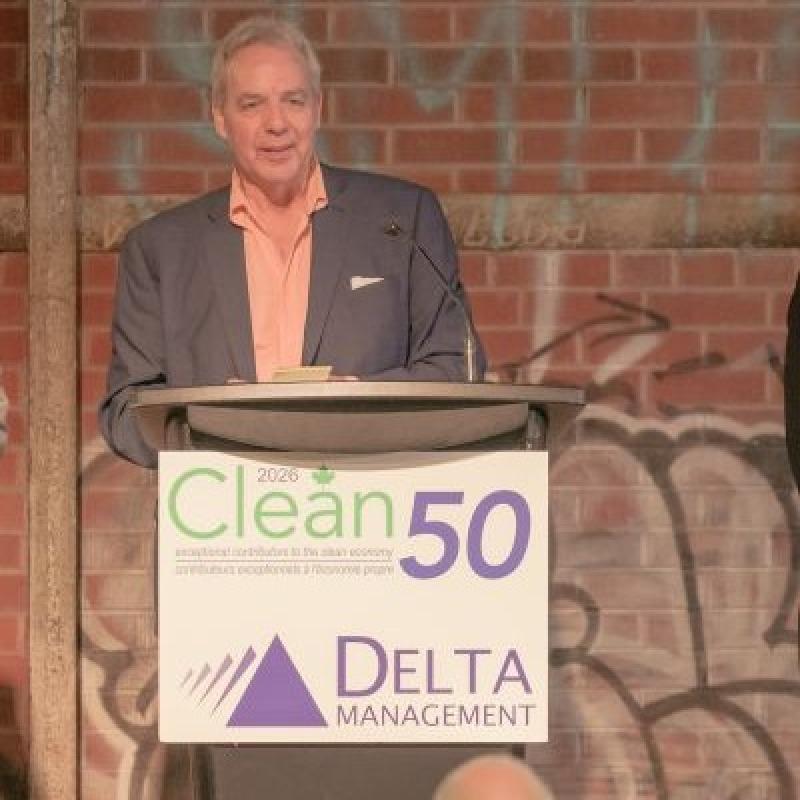
Canada’s Clean50, an awards program for the country’s sustainability and climate leaders, is in dire financial straits, its organizer said, putting future events and winners lists in question unless the gap can be covered.
An email from Clean50 last week sounded the alarm that it “desperately” needs sponsors. “If we cannot find the support we need, this coming Clean50 will be scaled down, and be the last,” it warned.
“We’ll run through this year. I will fund it out of my own pocket this year if I need to,” Gavin Pitchford, the executive director of Clean50, said in an interview with Sustainable Biz Canada. “I just won’t commit to doing that past the end of this year if we can’t get some sponsors.”
Clean50 has lost over half of its sponsorship dollars over the past year, he said.
The program “can no longer shoulder a burden this size without more help,” the email said, saying it is short approximately $50,000 for its upcoming summit.
Blows to sustainability industry impacting sponsorships
Pitchford is also the CEO of Delta Management Group, a Toronto-based search firm for Canada’s sustainability and climate action industries. Delta started Canada's Clean50 in 2011 because Pitchford felt “there’s no way we’re going to solve the climate issue without bringing together every single possible player to contribute.”
Clean50 organizes awards that recognize individuals or small teams, top projects, emerging leaders and lifetime achievement. Winners covered by Sustainable Biz Canada include Keith Ippel and Caroline von Hirschberg, co-CEOs of Spring Activator Inc.; Winston Morton, CEO of Climative; and Keith Cleland, CEO of Aqua-Cell Energy Inc.
Madison Savilow, the director of corporate and external affairs for Calgary-based Carbon Upcycling Technologies Inc., was named one of Canada's emerging leaders in the 2026 awards. The summit she attended "created a rare opportunity to reconnect, meet new people, and have conversations with experts working across completely different industries and approaches to sustainability," Savilow said in an email exchange with Sustainable Biz Canada.
In the past, Clean50 could recoup lost funding by finding new sponsors. “This year it’s just not there,” Pitchford said. The rollback of corporate sustainability in North America, the impact of tariffs on businesses and unfavourable political shifts for the green economy have hammered Clean50’s sponsors, he said.
Prime Minister Mark Carney has “recklessly ignored the climate as one of the core principles of what he is doing,” Pitchford added, such as weakening the carbon price. It becomes a signal to businesses to cut back on sustainability, he explained.
Pitchford noted sustainability consulting in Canada is being “decimated” as another example. He recalled how someone from a Big Four consultancy told him their sustainability business was growing by 25 per cent per year at one point. But in the first nine months since Carney took office, that plunged by 45 per cent. Pitchford said there is an ongoing exodus of Canadian sustainability consultants who are moving to Europe for jobs.
A major sponsor and enthusiastic backer of Clean50 clawed back its support due to the Trump administration’s opposition to corporate environmental and diversity policies, he added.
Compounding these problems, inflation has significantly raised the cost of hosting events.
Funding being bridged, but not enough yet
If there is a budget shortfall for Clean50, Pitchford said he pays out of his own pocket to cover the gap. That has been made more challenging because Delta too is seeing business slow down as of late.
“I don’t mind covering a shortfall, but small. But I can’t put in 1,000 hours per year and cover a big one,” he said.
Though supporters such as Vancity and one-man firm ECO Strategy have helped cover some of the deficit, Clean50 still has tens of thousands of dollars to cover if it is to continue. The next Clean50 Summit is expected to take place in downtown Toronto this year on a date that is yet to be determined.
If Clean50 ceases to operate, Pitchford said it would be a heavy loss for the industries and professionals it recognizes. The annual summit leads to over 1,000 collaborations per year, he said.
It would be disappointing to see Clean50 scaled back, "given the role it has played in building connections and community within Canada’s sustainability ecosystem," Savilow said. If Clean50 were scaled back or cancelled, she said it would mean the loss of the community and cross-sector network it has built.
"Those opportunities to connect, learn from each other, and stay inspired are incredibly valuable, especially in work that can often feel complex and long-term."



 Industry Events
 Locations