
 Locations







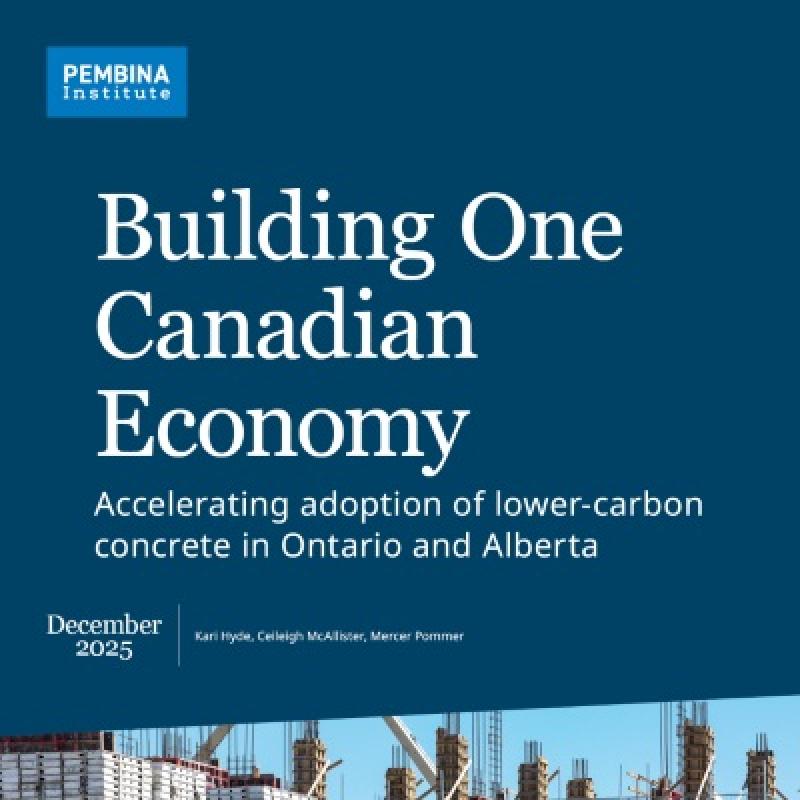
Canada can build its major projects with less climate-warming pollution and tap into a major economic opportunity by removing the barriers to decarbonized concrete production, a report by the Pembina Institute suggests.
Released Friday morning, the Calgary-based think tank argues in Building One Canadian Economy the country can meet two goals — a massive build-out of critical infrastructure and its climate targets — by looking at the ways the multibillion-dollar concrete industry in Ontario and Alberta is reducing carbon emissions.
“Both provinces set an example in terms of how far along they are as global leaders,” Kari Hyde, the manager of utility and demand-side management at the Pembina Institute's buildings program, said in an interview with Sustainable Biz Canada.
As Canada embarks on a major projects initiative, requiring enormous volumes of concrete to build energy infrastructure, roads and housing, it is an opportune moment “to ensure that trade barriers are reduced, that we have the ability to use cleaner construction materials in the big nation-building moment,” she said.
Concrete production is responsible for approximately seven per cent of the world’s greenhouse gas emissions. The making of cement, a key concrete ingredient, contributes approximately 1.5 per cent of Canada’s carbon emissions, according to the Canadian government.
Ontario, Alberta leading in lower-carbon concrete
The Pembina Institute chose to highlight Ontario and Alberta in the report because the two provinces are Canada’s first- and third-largest concrete markets respectively, and are taking distinct, complementary paths to decarbonization.
The think tank noted Ontario’s concrete players are leading in the use of lower-carbon cement substitutes. One example is the Ash Grove plant in Mississauga, where technology made by Calgary-based Carbon Upcycling will be integrated.
Alberta’s concrete sector is pushing ahead of the pack with use of carbon capture, utilization and storage (CCUS) technology, the Pembina Institute said, highlighting Heidelberg Materials’ plan to build the world’s first full-scale CCUS facility at its site in Edmonton.
Additionally, Alberta’s concrete producers are testing other innovations such as using lower-carbon fuels for kilns and developing more sustainable supplementary cementitious materials.
The Pembina Institute notes Canada’s cement and concrete producers have already made progress in reducing the carbon emissions of standard mixes by 13 to 20 per cent since 2017, depending on the region.
Though there have been positive steps to decarbonization, the Pembina Institute identified regulatory and economic barriers and gaps for the low-carbon transition of Canada’s concrete industry.
Those include outdated codes, standards and specifications, a “disorganized procurement that makes it difficult to invest with certainty,” and “uncertainty across the value chain” for architects, engineers and procurement officers, Ceileigh McAllister, a Pembina analyst and contributor to the report, said in an interview with Sustainable Biz Canada.
The report lays out a series of suggestions to overcome such obstacles.
Nationwide alignment key to report's suggestions

Instead of prescriptive building codes and standards, the institute recommends a performance-based approach focused on the outcomes of low-carbon concrete and improving alignment across provinces.
For example, a performance-based approach to building codes could be widely adopted, which would reduce costs, cut red tape and spark innovation, Hyde said.
Governments, which make up approximately one-third of demand for concrete in Canada, are a powerful buying force with the ability to shape the market. The Pembina Institute says the federal standard for embodied carbon reductions in projects of a certain size and budget could be adopted by provinces.
The adoption could be pushed through reinvestment into investment tax credits or development charge rebates from provincial carbon pricing mechanisms, Hyde said.
“There are proven technologies . . . that are market-ready, and that can be used in construction projects to meet the federal standards. It is entirely doable,” McAllister said.
Last year, the Pembina Institute published a report urging governments in Canada to prioritize low-carbon concrete in procurement policies.
Finally, the Pembina Institute found industry concerns over the confidence of lower-carbon concrete and varying levels of expertise to handle the material. To educate the sector, the institute recommends the creation of a toolkit that will provide resources, training, guidance and peer networks to assist in the adoption of lower-carbon concrete products.
The Canadian concrete industry has been highly interested in the recommendations laid out in the report, McAllister said.
“We’ve identified that industry wants this.”


 Industry Events
 Locations