
 Locations




Only a few months after emerging from its stealth phase, CURA Climate Inc. has secured Lethbridge, Alta.-based Grand Forks Concrete Ltd. as a partner for its first pilot- and commercial-scale projects.
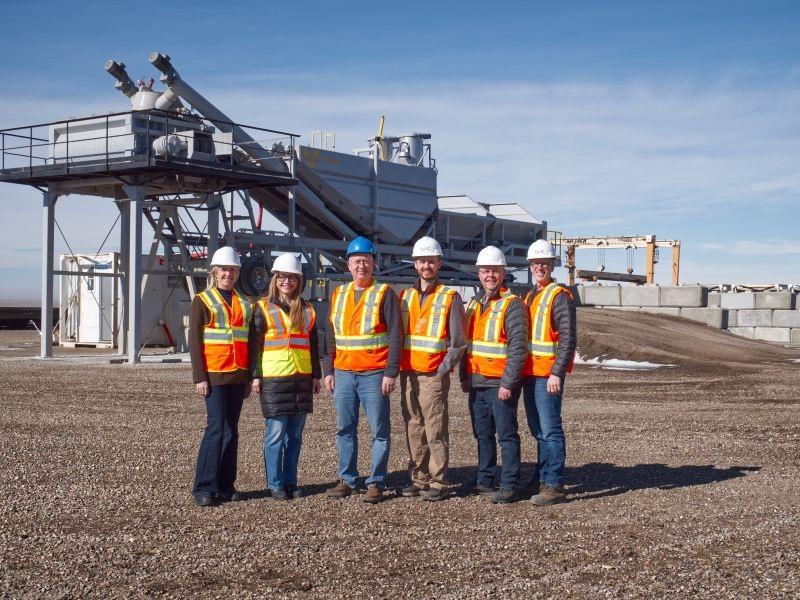
The Calgary-based company plans to deploy its means of producing a low-carbon cement ingredient at Grand Forks’ precast concrete production site in Taber, Alta.
The first step is for CURA to complete feasibility testing in Calgary. Second, the climate tech startup aims to deploy a pilot project at Grand Forks’ facility. It then plans to run a small commercial facility on the same site, as it works toward global expansion on a much larger scale.
The partnership would be the world's first commercial-level cement production using an electrochemical process, Erin Bobicki, CURA’s CEO, told Sustainable Biz Canada in an interview.
Grand Forks is a great fit for CURA because its leadership voiced strong demand for low-carbon cement and Grand Forks’ size matches CURA’s current scale, she said.
“They’re very open to innovation and trying new things ... Just a real alignment around values in terms of sustainability and business best practices.”
CURA-Grand Forks partnership
CURA's team first met Grand Forks at an Emissions Reduction Alberta event. Grand Forks was searching for a source of low-carbon cement, but was struggling to find a supplier, Bobicki said. After a conversation with Grand Forks’ leadership, the company took an interest in CURA’s technology.
The cement industry is the source of approximately eight per cent of the world’s carbon dioxide (CO2) emissions, a problem CURA is aiming to address. The company’s process produces hydrated lime, a cement ingredient, by using renewable electricity and electrochemistry to split limestone. This results in up to 85 per cent less CO2 compared to the traditional method of burning limestone in kilns to produce lime, the company says.
The first phase of the CURA-Grand Forks partnership is characterization and feasibility, which is currently taking place. CURA is taking limestone from the Taber area and running it through an electrolyzer to produce lime and cement in its Calgary lab, a step expected to be finished in two months, Bobicki said.
Phase 2 is designed as a pilot deployment of CURA’s technology in Grand Forks’ Taber facility, capable of producing 100 tonnes of hydrated lime per year. Testing the cement made from the lime and early revenue generation are the goals for Phase 2. CURA is on the engineering stage of this phase, which is on track to being commissioned by late 2026 to early 2027.
For Phase 3, CURA plans to service small-scale commercial production in the range of 30,000 tonnes of hydrated lime per year alongside Grand Forks. CURA aims to have the facility for Phase 3 running in late 2028.
CURA plans to use waste agricultural lime as the feedstock for Grand Forks, which would be sourced from local processing in the area famed for its corn production.
CURA’s commercialization plan
The partnership with Grand Forks would be a critical first step in CURA’s path to worldwide expansion. CURA’s goal is to supply its equipment to large cement industry companies, helping to produce 500,000 to one million tonnes of hydrated lime per year by 2030.
The company plans to start this by being integrated in a large production facility. “Once we’ve proven at that larger scale, then we plan to deploy across the cement industry – supplying equipment and licenses to sites all over the world,” Bobicki said.
CURA has signed memoranda of understanding with cement producers located in Canada and Europe to meet this target, Bobicki said.
Regulations in Europe are putting heavy pressure on cement producers to reduce carbon emissions, she explained, which CURA can help achieve. Also, CURA can let companies make low-carbon cement at or below cost parity, furthering the argument for adoption of its technology, Bobicki added.
The company expects to launch its seed funding round in Q2.
It also has more partnerships with companies to announce, Bobicki disclosed. In February, CURA announced a partnership with Toronto-based construction firm Aecon Group Inc., which will involve Aecon testing CURA’s technology and possibly using cement made through the process for a commercial project.
“We are scaling extremely rapidly, particularly for this space; getting a lot of traction, hearing that this is a solution that the cement industry needs,” Bobicki said.




 Industry Events
 Locations