
 Locations



Projects that benefit the environment and society remain a keystone of Stantec’s work, its senior vice-president of corporate sustainability Carrie Sabin said, with some of its strongest growth potential often oriented around such priorities.
The Edmonton-based engineering, architecture and environmental consulting firm summarized its efforts to tap into the opportunity in its 2025 sustainability report. Stantec put the spotlight on major projects with a sustainability angle and its endeavour to achieve net-zero operations.
Stantec disclosed 68 per cent of its gross revenue, or $5.5 billion, was linked to the United Nations Sustainable Development Goals such as affordable and clean energy, climate action and gender equality. Its percentage of revenue aligned with such values has continued to climb since Stantec began tracking the figure, which started at 43 per cent in 2019.
Sustainability, Sabin said, is “pretty key to our strategy.” The value is resonating with its leadership and employees, she continued, and has been deeply embedded within the company.
Stantec’s projects
Stantec handles thousands of projects at once, and almost all have sustainability elements, Sabin said.
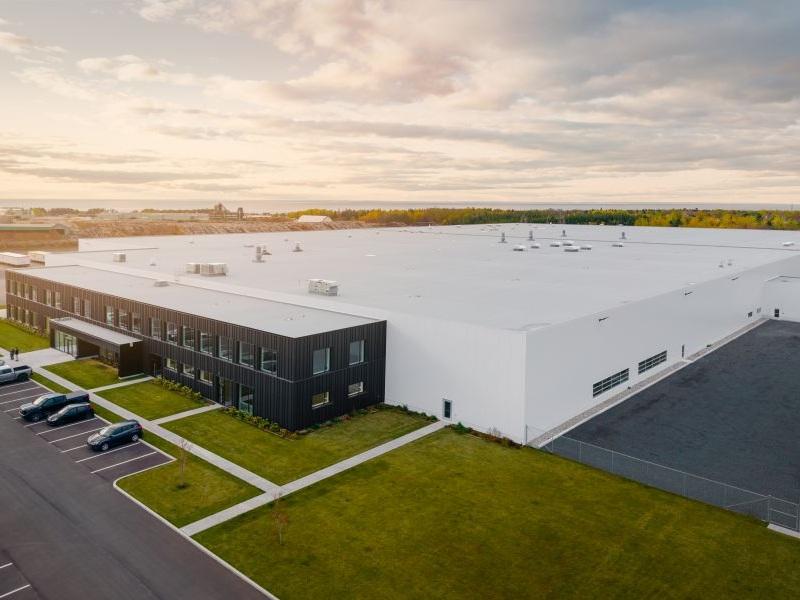
An example in the report is Stantec’s work on a carbon-neutral ceramic facility in Quebec, owned by Duravit. Stantec’s building engineering services team designed the building’s systems to support electric kilns, offsetting 9,000 tonnes of carbon dioxide emissions per year.
“The approach not only drives renewable energy use and alternative energy sources, but also has a direct carbon reduction and pretty significant economic benefits for the region,” Sabin said about the project.
Another example is its partnership with the North Shore Tribal Council in Ontario, where Stantec used its First Nation Infrastructure Resilience Toolkit to assess climate vulnerabilities and develop adaptation strategies to strengthen Indigenous communities’ infrastructure and natural systems.
Restoring and protecting nature often plays into Stantec’s services. The company partnered with non-profits and government agencies in the U.S. to address forest health and climate resilience, participated in an effort to revitalize five fish-bearing tributaries in California, and worked to protect freshwater resources in Egypt while supporting the design of eight wastewater treatment plants for thousands of people.
Stantec’s success on Scope 1 and 2 emissions

Stantec has set out to cut its Scope 1 (direct) and 2 (electricity) market-based carbon emissions and Scope 3 (supply chain) business travel emissions by 47 per cent by 2030 against a 2019 baseline.
It has already exceeded its Scope 1 and 2 emissions target, which was slashed by 70 per cent as of 2025. Stantec has relied on renewable electricity and carbon offsets to reach operational carbon neutrality for the fourth year in a row.
In 2025, 97 per cent of its electricity was sourced from renewables – the same as in 2024. Stantec purchases energy attribute certificates and green tariffs to access renewable electricity, Sabin said. For its Canadian operations, Stantec plans to replace the energy attribute certificates with a virtual power purchase agreement, she added.
Stantec has managed to maintain its high renewable energy use despite rapid growth, Sabin said. That said, it did struggle to source renewable energy in the Middle East and Taiwan, she added.
To cut its business travel emissions, Stantec is encouraging employees to take low-carbon transportation options. When selecting new offices, it prioritizes easy access to public transit and strong environmental performance, Sabin said. The company has programs that help its employees switch to electric vehicles and has charging stations in some locations.
Stantec has been less successful in meeting its business travel target ahead of time, as it was reduced by 30 per cent as of 2025.
To balance out residual carbon emissions in 2025, Stantec purchased offsets from sources such as Indigenous-led ecosystem conservation projects, concrete carbon capture (from Canadian firm CarbonCure) and sustainable aviation fuel (from Air Canada and Delta Airlines).
On an intensity level, Stantec’s Scope 1 and 2 emissions fell by 14 per cent from 2024; its business travel emissions decreased by 17 per cent over the same period.
To address the waste from its operations, Stantec partnered with electronics recycling providers in 20 countries, used its centralized print services program to standardize post-consumer recycled paper, and sold, donated and recycled furniture during office renovations in Canada.
Sustainability “not a hard trade-off”
As a consultant, Stantec engages its clients on incorporating sustainability early in their projects, Sabin said. An example she gave was the company encouraging its consultants to discuss environmental considerations with their clients.
There are times when the company rejects a project because it lacks the sustainability criteria that Stantec seeks, she added.
Stantec has only benefited by focusing on sustainability, Sabin said. Its pursuit of greener operations is engaging its staff, and clients are reaching out to Stantec because it puts sustainability at the forefront, she explained.
“It’s not a hard trade-off for us because it really connects to who we are as a business culture . . . It definitely brings us more revenue.”



 Industry Events
 Locations