Locations






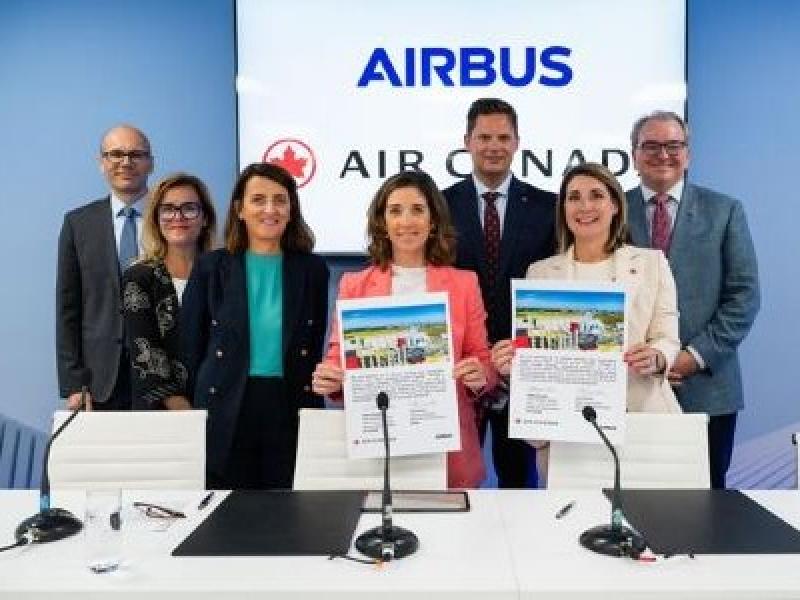
Air Canada and Airbus plan to launch a jointly funded $13.7-million investment platform to support a commercial-scale sustainable aviation fuel (SAF) industry in Canada, with the goal to shrink carbon emissions from airline jets.
Announced Monday morning by Canada’s largest airline and the French aerospace company, a focus of the partnership is accelerating a Canadian SAF project to the final investment decision. Both companies aim to collaborate with government partners to establish the “structural frameworks to support SAF production” they said in a release.
The purpose of the joint initiative is to make steps toward “supporting domestic SAF production, helping corporate customers address the emissions associated with business travel, and contributing to a lower-carbon path for the industry,” said Valerie Durand, Air Canada’s vice-president of airport affairs, corporate real estate and sustainability.
The co-investment structure of the platform is being finalized, Catherine Guillemart, head of public affairs for Airbus in Canada, said in an email exchange with Sustainable Biz Canada.
Airbus and Air Canada, she continued, are assessing multiple projects for potential joint co-investment structures. "We do not limit our platform to any particular type of SAF pathway or feedstock," Guillemart said, listing oily feedstocks, woody biomass and agricultural residues as examples.
Raising the trickle of SAF production
Aviation is not a massive contributor to Canada’s transportation greenhouse gas emissions, calculated by Transport Canada to be responsible for 1.2 per cent of total emissions in the country in a 2026 report. However, the sector’s carbon emissions have been steadily rising since 2005.
In an effort to decrease the carbon emissions from airliners and contribute to 2050 net-zero targets, the Canadian government and industry groups have promoted SAF. As most of aviation’s climate-warming emissions stem from its fuel use, low-carbon synthetic fuel would help tackle the issue.
SAF feedstocks can be crops, waste from forestry, agriculture, food and municipalities, and a mix of captured carbon dioxide and hydrogen.
The Canadian Council for Sustainable Aviation Fuels, a consortium of aviation industry businesses operating in Canada, launched a strategy in 2022 to lead to the production of one billion litres of SAF in Canada by 2030, representing approximately 10 per cent of the country’s consumption.
SAF production is a trickle today, forecast to supply less than one per cent of the world’s aviation fuel consumption in 2026. As of 2025, there is no commercial SAF production in Canada, the Transport Canada report states.
“As 2030 approaches, the likelihood of commercial production by that time decreases based on a number of reasons,” the document continues, such as considerably higher costs compared to conventional jet fuel and policy uncertainty.
The Air Canada-Airbus partnership is another attempt to bridge the production gap by investing in SAF projects.
Air Canada already using SAF
Air Canada and Airbus did not yet say how much SAF production they plan to support through the partnership.
Guillemart said Airbus identifies SAF as capable of reducing life-cycle carbon emissions by up to 80 per cent compared to conventional jet fuel. The carbon emission reductions from the partnership would mostly depend on the feedstock used, she added.
Canada has “vast feedstock potential,” Julie Kitcher, Airbus’s chief sustainability officer and communications, said in the announcement. “When combined with a supportive policy framework, it can contribute to the sector’s decarbonization ambitions and create significant economic growth and job creation.”
Growing Canada’s domestic SAF production to meet 40 per cent of the country’s aviation fuel needs by 2040 could generate $32 billion and create 140,000 jobs, a report by Airbus and ICF said.
Air Canada has the ambition to be net-zero by 2050. It also has 2030 interim targets of cutting the carbon emissions from its air operations by 20 per cent and ground operations by 30 per cent — both relative to a 2019 baseline.
The country’s flag carrier has taken early steps on SAF consumption. In 2024, it unveiled the purchase of almost 78 million litres of unblended neat SAF from Neste. Also that year, Air Canada bought approximately 101,000 litres of low-carbon aviation fuel produced by Parkland from its Burnaby, B.C. refinery.
Additionally, Air Canada has a $50-million research and development fund it said could be used to help scale the SAF market.
Combined with other efforts such as adopting more fuel-efficient aircraft, Air Canada has seen the carbon emissions from direct fuel combustion taper off slightly since 2019. In its 2024 sustainability report, the latest to date, it disclosed 12.1 million tonnes of carbon dioxide emissions in 2024 in the category, compared to approximately 13.2 million in 2019.



 Industry Events
 Locations