
 Locations







The cost to install and manage charging infrastructure in buildings is a critical factor in the affordability of electric cars, Schneider Electric Canada’s head of mobility Stephanie Medeiros said. Luckily, there are several solutions that exist today.
While the conversation around electric vehicles (EVs) primarily revolves around the sticker price of the cars, Medeiros noted the role of charging the battery. Such a factor adds to the lifetime costs and can extend the break-even point compared to a gas-powered car if not addressed.
“I know that a lot of conversations around EV affordability are around the vehicle price and incentives . . . But it’s definitely important to look at the total cost of ownership,” Medeiros said in an interview with Sustainable Biz Canada.
Equipping a single-family home with a charger and upgrading the electrical capacity can easily run into the thousands of dollars, for example. If an EV owner charges their car at peak hours, it would run up the electricity bill.
However, there is a simple change to habits and use of certain technologies that can cut costs and make the EV transition more affordable, Medeiros said.
Why home charging is the first place to target
Most EV charging in Canada is done at home, making residential buildings a priority to address when it comes to the costs.
A target Medeiros identified is the increased electricity demand to charge an EV at home, adding more demand on the power panel. Flo, a Quebec-based EV charging network operator, said most Level 2 home charging stations are rated up to 50 to 80 amps.
The issue is that many residential buildings were not built to account for EV chargers; Flo said some homes may be limited to 60 amps. If the owner wishes to install an EV charger, it would require a panel upgrade so the breaker capacity is not reached.
Making this adjustment adds costs. In Ontario, the panel upgrade alone could cost between $1,500 and $3,000, according to Hamilton, Ont.-based ElectricSafe.ca, not accounting for electrician labour and permits. Such fees are fairly consistent across Canada, BrokerLink said.
The cost to install an EV charging station in the parking spot of a condo in Ontario can range between $5,000 and $10,000, metroEV said.
Charging behaviour, technology can help
The easiest way to reduce EV charging costs is to avoid the temptation to plug in the car when coming home right after work, and instead waiting until energy rates are as low as possible, Medeiros said.
In Ontario, the ultra-low overnight rate is 3.9 cents per kilowatt-hour. During peak hours, that balloons to 39.1 cents per kilowatt-hour. By charging at the ultra-low overnight hours, the EV owner saves dollars every week.
Another recommendation from Medeiros is to charge as much at possible at home or in the workplace, instead of plugging into public chargers. Public charging incurs higher fees compared to topping up the battery at home or work. Plug’n Drive, a Canadian non-profit, said pay-per-use Level 2 chargers cost on average between $1 to $2.5 per hour.
As for technological solutions, the first one Medeiros named was smart charging. Certain chargers will optimize the charging sessions based on energy demand, drawing on signals from the panel or grid to throttle output if necessary. Smart charging technology can automatically top up the battery at off-peak hours to save costs or avoid moments when the grid is most strained to further reduce fees.
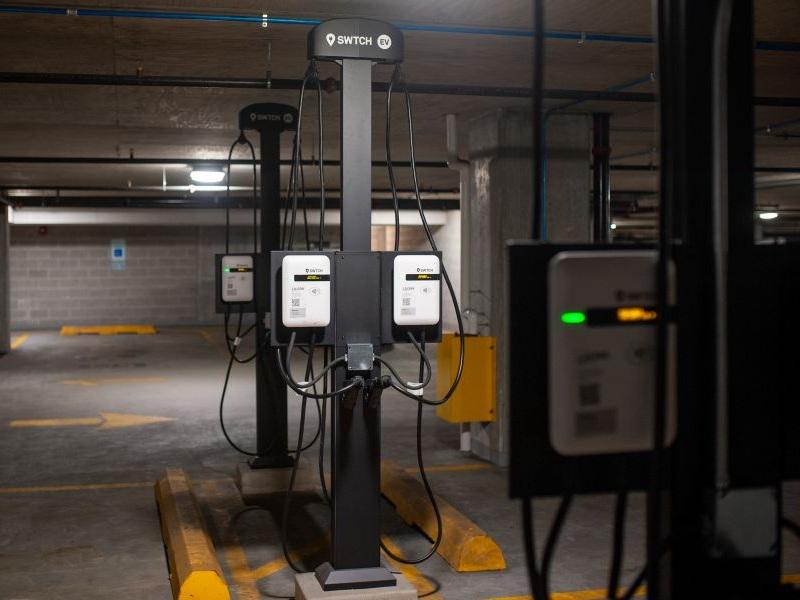
For multi-unit buildings, Medeiros pointed to load management. The technology regulates the building’s electricity capacity so power is distributed equally to chargers, ensuring the capacity is not breached and every EV is topped up evenly.
“The idea is not to have the electrical capacity to charge all of these vehicles at the same time at full power,” Medeiros said.
Reducing costs helps with EV transition
By adopting these technologies and behaviours, homeowners and building owners can avoid costly service and infrastructure improvements, Medeiros said. By shrinking the financial burden, the solutions can reduce the cost of EV adoption and help boost the number of electric cars on the road, she continued.
There are no major barriers to adopting the technologies or behaviours today, Medeiros said.
“That’s why it’s important to make things as simple as possible, as cost effective as possible.”


 Industry Events
 Locations