
 Locations





RBC (RY-T) is expanding its renewable energy procurement strategy by launching its Community Solar Program, which will support community solar projects while helping the bank meet its emissions reduction targets.
Announced last week with inaugural projects in Manitoba and Prince Edward Island, RBC is to purchase renewable energy certificates (RECs) over a 10-year period from solar panels installed on participating community organizations’ properties.
The RECs would count toward the Toronto-based bank’s greenhouse gas emission reduction targets, while the community organizations can benefit from an additional revenue stream by selling the certificates to RBC.
The program allows RBC to source more renewable energy from areas it operates in and help decarbonize electricity grids, Jon Douglas, RBC’s head of climate operations and originator of the program, said in an interview with Sustainable Biz Canada.
“I’m really excited about the future of this program and where we can take it.”
Making solar projects more economically viable
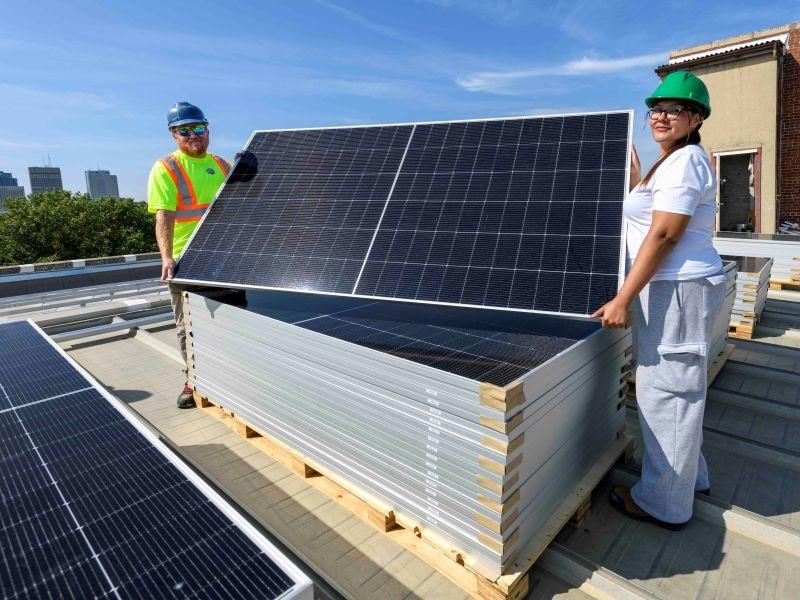
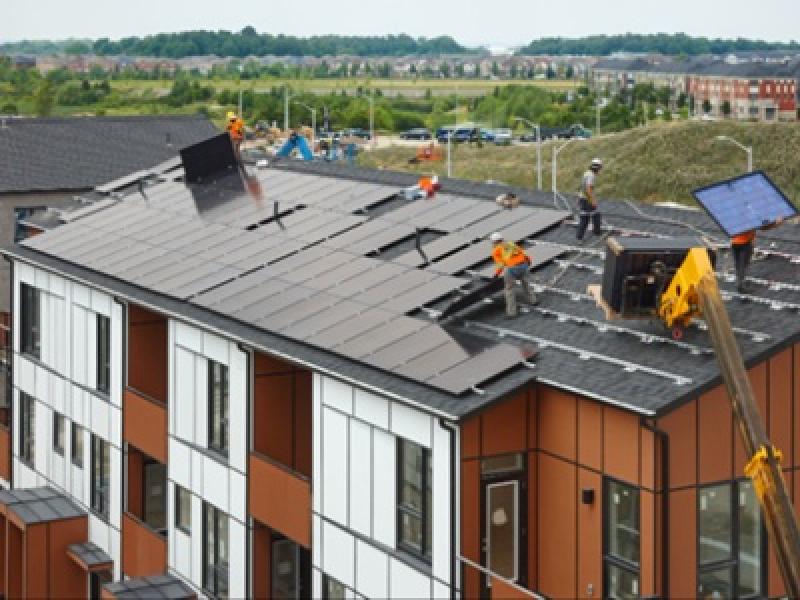
The bigger of the two initial projects is being developed by BUILD, a Winnipeg-based Indigenous non-profit contractor and training program. The 109.8-kilowatt installation is expected to generate enough electricity to power approximately 12 homes. Additionally, the project can serve as a hands-on training opportunity for BUILD’s trainees, RBC said.
Permitting for the BUILD installation is being ironed out, Douglas said, and once finished, the asset can be operational.
The installation in Prince Edward Island is located on the grounds of Holland College, consisting of arrays at its Prince of Wales Campus in Charlottetown and the Atlantic Police Academy in Summerside. The 104.7-kilowatt solar project is already operational, Douglas said.
RBC’s partnership with the community groups make the projects “a bit more financially viable because they’re not just having to rely on the electricity savings alone,” Douglas said. “Now there’s this second revenue stream.”
The certificates would be used to reduce RBC’s Scope 2 market-based emissions, which come from electricity and steam consumption.
RBC has used RECs to source renewable energy in order to reduce its Scope 2 emissions. In 2025, RBC achieved emissions reductions of 64,018 tonnes of carbon dioxide equivalent (tCO2e) from purchases of energy attribute certificates (EACs) such as RECs. Those reductions mark a substantial improvement from its 2018 baseline of 5,028 tCO2e.
The RBC Community Solar Program, Douglas said, is a scalable model that could be applied across Canada. For example, it could be used to support solar installations in affordable housing projects or community centres.
RBC is keeping the program’s attention on Canada for now, but Douglas disclosed the bank has had conversations with its U.K. branch about the program.
RBC seeking more renewables for decarbonization
In 2023, RBC sourced 100 per cent of its electricity from renewable and non-emitting sources for all of its properties. A year later, the goal was adjusted to sourcing all of its electricity from renewable sources for all of its properties.
In its 2025 sustainability report, the bank reiterated its ambition to source all of its electricity from renewable energy, primarily through EACs, with the aim of sourcing from the regions it operates within.
RBC raised its EAC electricity procurements from 20,000 megawatt-hours (mW-h) in 2018 to 416,033 mW-h in 2025.
RBC, Douglas said, is buying more clean electricity to power its operations as it transitions from fossil fuel generation to electricity. For example, RBC is installing electricity-powered heat pumps to retrofit the Canadian retail branches it controls by 2035, beginning with a $35-million investment spanning 2025 to 2027.
Another step it has taken is engaging its land owners through its Landlord Engagement Program, where RBC is adding climate-focused lease clauses in its new and renewed lease agreements. A key example is its headquarters, Royal Bank Plaza, which is following a pathway to net-zero by 2040 under the initiative.
The vast majority of RBC’s greenhouse gas emissions are from its financing of sectors such as energy and agriculture.


 Industry Events
 Locations